
What this guidance covers
This guidance introduces the PRIME framework – Plan, Respond, Implement, Monitor, and Evaluate – to help keep public information discoverable, accurate, and trusted across AI search platforms. You can read case studies on how teams are using PRIME to adapt their content.
Why you need to read this guidance
AI is changing the way people are searching for information and this is becoming more commonplace. An Ofcom report on online habits published in December 2025, showed that nearly two-thirds (65%) of Brits look up information online every day. More than a third of Gen Z (43%) and Millennials (40%) do so six or more times daily.
The UK Government is responsible for supporting people with vital, accurate information from health and security issues to how to pay taxes or claim benefits. If we don’t respond to this challenge, we risk outdated, incomplete or, worse still, inaccurate information reaching our audiences, with real world consequences. There is a reputational risk when government responses do not show up reliably in AI search outputs.
What you can start doing now
You can help maintain trust and improve how AI search tools process your content by applying the PRIME framework across 5 steps:
- Plan and prepare your content by auditing and archiving outdated, duplicate, or inaccurate pages.
- Respond to user habits by adapting content to directly answer your audiences’ queries.
- Implement technical standards, structured data, and clear page layouts so automated search tools can process your content accurately.
- Monitor how AI search outputs present your content, tracking errors or missing information in real time.
- Evaluate your content’s performance continuously using an ‘always-on’ approach to maintain accuracy over time.
Who this guidance is for
This guidance is critical for everyone in Government Communications, including Press, Data and External Affairs colleagues.
The rise of AI-mediated search
Artificial intelligence has accelerated rapidly in recent years. AI-mediated search refers to search engines and tools that use artificial intelligence to generate direct answers rather than simply displaying web links.
As AI transforms how people find information online, large language models (LLMs) – the technology powering AI summaries – may fail to surface official information. Without proactive content optimisation, this allows misinformation to spread.
To stay visible, our content must be easy for both our audiences and AI tools to find and understand. This approach is called generative engine optimisation, or GEO. If our content is not AI-ready, people may receive inaccurate or outdated information about government services.
This guidance applies to all government communicators. It covers all public-facing content, from official announcements to social media posts. Apply these techniques together with your GOV.UK, digital and policy teams. GEO is evolving quickly, so you should treat this guidance as a starting point, not a fixed set of rules.
Search is changing user behaviour
As search engines and chatbots answer queries directly on results pages, we cannot assume users will click through to official websites. Research published by Studio 36 Digital in 2025 indicates that over 54% of UK online searches now result in zero clicks to external sites. So you need to make sure your communications remain accurate and discoverable wherever people search.
Search capabilities are expanding rapidly in two main ways: platform variety and user behaviour.
Expanding search platforms
People use a growing range of search channels. Beyond traditional search engines like Google or Bing, millions rely on dedicated AI search platforms, such as the following:
- Gemini (Google)
- AI overviews
- AI Mode in Google
- Co-Pilot (Microsoft)
- ChatGPT (OpenAI)
- Claude (Anthropic)
- Perplexity (Perplexity AI)
- Grok (xAI)
- Deepseek (High-Flyer)
Because people search in different ways, audiences now use many different tools to find information.
Evolving user habits
People are searching differently. The YouGov Great Britain AI Search Report 2026 confirms that search engines are the most popular channel across all age groups. However, search habits vary significantly by demographic:
- 42% of millennials use AI assistants to search for information.
- Gen Z rely heavily on alternative search channels, with 49% using social media and 37% using online communities or online forums.
Leading AI search use cases include direct answers, content summaries and fact verification. Among AI search users, 71% increased their usage over the past year, while only 5% reduced it.
Managing the web ecosystem
These behavioural changes are significant because government holds public information across many channels, including forums, social media, Wikipedia and Reddit. Without regular reviews, policy updates and emerging issues can leave external pages outdated or contradictory. Maintaining consistent information across third-party platforms is just as important as optimising content for GOV.UK.
Achieving GEO success requires broad collaboration. Engage early with policy, digital, product, and Government Digital Service colleagues managing GOV.UK uploads, as well as external partner networks.
Our responsibility
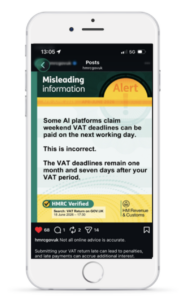
Because government communications reach millions of people, keeping content accurate, current and AI-ready is essential. When official webpages contain incorrect information, AI outputs risk repeating and amplifying those mistakes. This was an issue for HM Revenue and Customs (HMRC) who identified unofficial sources circulating incorrect VAT deadlines online. Learn how HMRC addressed the issue using their ‘HMRC-Verified’ approach in this case study.
Build GEO considerations into your initial planning rather than acting on them later. If you optimise well for SEO, you’ll also help your content perform well for GEO and AEO. For more information, consider reading Google’s SEO starter guide and the Public Relations and Communications Association (PRCA) guidance on How to make your content fit for AI search.
How search queries are changing
While short keyword searches still happen, AI search tools encourage people to type longer, conversational, natural-language questions.
The average query in Google AI Mode is three times longer than a traditional search query. Searches are becoming more specific and personalised.
Search is also moving beyond text, to combine images, audio and video. Multimodal (non-text) inputs now make up more than one in six Google AI Mode searches. Image-based searches are among the fastest growing query types, rising by over 40% every month.
Use our PRIME framework
Making content AI-ready is not a one person job. Work with your communications, policy, digital, product and technical teams to make sure your content is clear, published in the right place and easy for computer systems to read. Improving individual pages will achieve little if these core foundations are weak.
We’ve created a framework called PRIME to help you: Plan, Respond, Implement, Monitor and Evaluate.
Plan
Understanding what your audience is searching for forms the foundation of AI search optimisation. Build an in-depth knowledge of their search queries so that you can answer their questions precisely.
Gather search insights
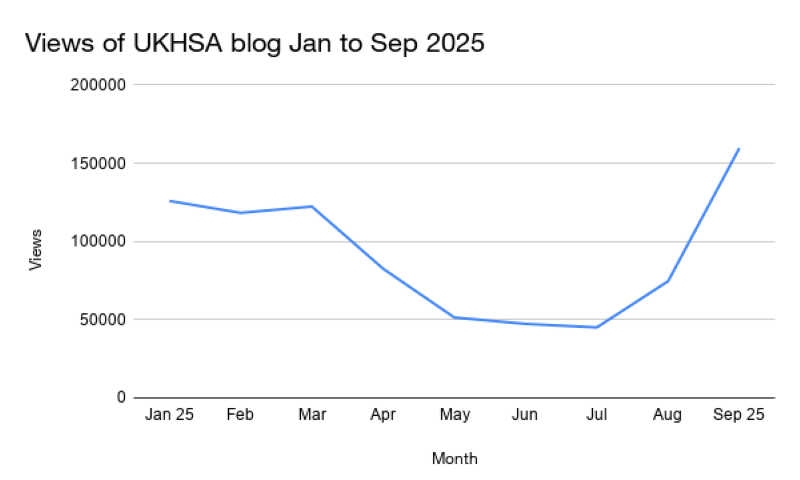
Tools like Google Trends, Hootsuite, Semrush and Brandwatch can help you to identify search patterns. For example, UKHSA colleagues used Google Trends to mirror the language people use when searching. They tested both updating existing posts and publishing new ones, to compare the effect on prominence. Find out how UKHSA optimised their content for AI search, which contributed to increased views of UKHSA blog posts, in this case study.
This guidance features selected tools not an exhaustive list. Because the AI search landscape changes rapidly, carry out an open search to find the best tool for your needs. Review public correspondence and user data to spot recurring questions. Partner with research agencies to observe your audiences preferred channels and understand the exact language they use.
Conduct content audits
Regularly audit public content alongside your internal and external stakeholders.
Make sure your audit covers:
- press notices, toolkits, factsheets and case studies
- campaign sites, microsites and ministerial speeches
- social media posts, influencer content and third-party sites
Adapt your high-priority content or content on high-traffic pages immediately rather than waiting to complete a full audit. Group audits by theme, priority or date, depending on your organisation’s needs.
Use AI tools safely
To help with your audit process, consider using tools like Assist (member-only content), our AI tool for government communicators, to scan uploaded text for contradictions, repetition or outdated facts.
When auditing with AI tools:
- Verify training cut-off dates for any LLM you use. You can usually find this information on the provider’s website.
- Always make sure a human with knowledge of your communications reviews the tool’s outputs rather than relying on automated outputs alone.
Archiving content
Your audit will produce a list of content to update or archive. Timely reviews and updates prevent AI tools from crawling outdated information and surfacing inaccurate outputs.
Departments, arm’s length bodies and public sector bodies cannot archive their own GOV.UK content, at the time of writing this guidance. The Government Digital Service is developing an archiving solution. In the meantime, continue archiving outdated content on your non-GOV.UK websites and channels.
Respond
Once you know what your audiences are searching for, create content that answers their questions directly. This section explains how a consistent webpage structure helps readers, AI tools, and search engine crawlers scan, index and surface your content.
Content structure
Follow GOV.UK’s writing guidelines to structure your content clearly:
- Use active, frontloaded and descriptive headings that describe what the section covers, and addresses what your audience is actually searching for.
- Answer the question in one line, immediately below the header.
- Provide supporting context and core details in the paragraph below the one-line answer.
- Place secondary background information or lower priority details at the bottom of the section.
Always write in plain English, following the GOV.UK style guide to keep sentences under 25 words, paragraphs short and lists bulleted for readability.
Collaboration and further guidance
If you’re writing new content, build these principles in from the start. Work closely with content designers, digital, media and policy colleagues, so you take a consistent approach when targeting the same audience.
For more information read the GOV.UK guidance on writing for user needs. You can also explore these articles on how to master GEO and how to write GEO friendly content.
Implement
After you’ve identified content to archive, review the content you are keeping. Make sure it follows the principles in our ‘Respond’ section, it can be accessed and indexed by web crawlers, and that it follows good AI search optimisation practice throughout.
Once your content is adapted, make sure it’s published in the right place and meets good technical standards. This means it’s accessible to everyone, easy for search engines to find and list (indexable), and supported by a clear, logical structure across your website (information architecture).
Monitor
Test how your most important content appears in AI search results, and keep track of the success metrics you’ve established. The ‘Evaluate and improve’ section explains which metrics to put in place.
The UK Health Security Agency doubled its blog traffic by monitoring Google Trends and tracking content performance in Google’s AI Mode. Read how UKHSA doubled blog traffic using AI search monitoring for the full case study.
Evaluate and improve
Optimising for AI search is an ongoing process. Frame your evaluation and success metrics around stages 1, 2, and 4 of the Government Communications Evaluation Cycle: Inputs, Outputs and Outcomes.
Because AI search optimisation is an emerging discipline without mature measurement standards, combine automated reports with manual spot-checking across AI engines. Submit direct feedback – such as clicking the ‘thumbs down’ icon on Google AI Overviews – when you identify inaccurate responses.
Inputs
Focus on the technical standards, content management and review processes you put in place.
- Review campaign content when activities end. Archive outdated pages, link live content appropriately and assign page owners for regular reviews.
- Make sure key pages use schema.org markup – standardised code that helps search engines understand page details – so automated tools process content accurately.
- Focus on readability and extractability by structuring content with clear, front-loaded headings, direct answers and concise points so AI tools can easily scan and extract information.
- Monitor latency and recency by tracking the time it takes for updated content to appear in AI search outputs, while maintaining a regular schedule to review your material.
Outputs
Measure how AI search platforms index, summarise and cite your public content. Read the ‘Selecting evaluation tools’ section for more details.
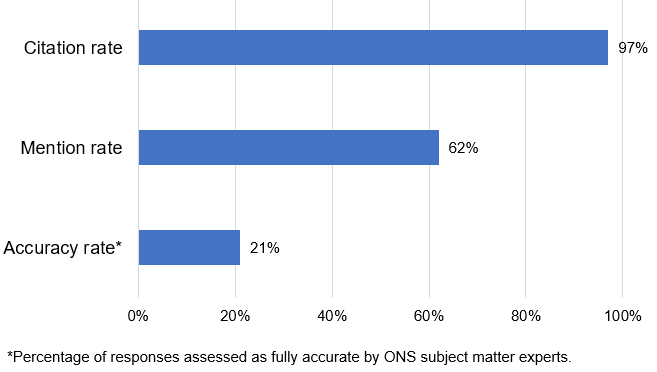
- Track citation frequency by measuring how often AI tools link to government pages as primary sources. As shown in the Office for National Statistics citation bar chart at the end of this list.
- Calculate answer inclusion rate by measuring the proportion of priority queries where government information appears within AI-generated summaries.
- Measure share of voice of government citations against third-party sources for the same query.
- Monitor referral traffic by measuring website visits originating from AI search platforms.
Why you should regularly schedule reviews
Technical algorithm updates can alter visibility overnight. For example, Reddit lost 86% of its ChatGPT citations in six days after OpenAI introduced domain-specific ‘site’ search operators.
Outcomes
Verify that AI engines represent government information accurately and serve your audience’s needs.
- Audit AI outputs regularly to ensure government information is summarised correctly without distortion or misattribution.
- Verify that key facts and terminology remain consistent when paraphrased by AI tools.
- Confirm that content directly answers public questions, including conversational and natural-language search phrasing.
Optimise content for paid AI search
The techniques you use to optimise organic content are different from the ones you use for paid. If you work in a marketing team, you will have specific campaign objectives covering both SEO and paid search. If you work outside a campaign context, you may be focused only on making sure accurate government information is visible through SEO.
Work with your media agencies and partners to identify the right paid search strategy for your campaign across all the platforms you use. Paid search options continue to evolve across platforms.
Government Communications works with WPP650 (the government’s media buying, planning and strategy agency) to assess the suitability of AI products for paid campaigns. Speak to your WPP650 account team for more information on paid optimisation techniques.
Measure success across budgets
Whether you deliver low-cost, unpaid, or paid campaigns, adopt an ‘always on’ approach to measure the effect of content updates. For example, ONS proactively recognised they had limited visibility on how their statistics were appearing in AI search results. They proactively developed a framework
Low-cost and unpaid campaigns
For no-cost or low-cost activity, carry out manual desk research alongside your in-house data and insight colleagues. Review your performance against the metrics outlined in our ‘Evaluate and improve’ guidance.
Paid campaigns
For paid campaigns, work with your agencies, partners, and insight teams to track how AI platforms and LLMs capture your content.
- Share evaluation data quickly with media agencies and your communications team to enable real-time content updates.
- Track paid search performance by monitoring key metrics such as onsite clicks, actions and application downloads.
- Establish accurate attribution by setting up clear tracking with your agency, reviewing marketing mix models and conducting incrementality tests – measuring whether ad spend generates extra results that would not happen anyway.
Selecting evaluation tools
Because AI search tracking is an emerging discipline, do not rely on a single measurement tool.
Test multiple platforms before making strategic decisions. The tools listed below illustrate available market options at the time of writing, and do not constitute an endorsement by Government Communications.
Traditional analytics and first-party webmaster tools
Use these to measure overall web performance, organic search metrics, and how well search engines index your content, rather than tracking how AI chatbots use or cite it.
- Google Analytics measures human referral and search traffic; now increasingly used to track inbound traffic coming from AI referrers.
- Bing Webmaster Tools (free to use) provides first-party data on how Microsoft’s indexers crawl sites and feed into Bing Search and Microsoft Copilot.
Combined SEO and AI visibility tools
The following combine traditional search tracking, such as keyword rankings and backlinks, with newer features for measuring AI visibility.
- Semrush AI Visibility combines multiple toolkits in a single dashboard view to help track, analyse, and improve brand presence on search engines, social media and AI-powered search platforms.
- Ahrefs Brand Radar focuses on improving brand visibility across AI outputs, YouTube and Reddit.
- Dragon Metrics is an all-in-one global SEO platform built to handle international search engines, local rankings and multi-region data.
Tools built specifically for AI chat visibility
Consider tools built specifically to measure the share of voice inside LLMs (ChatGPT, Gemini, Claude, Perplexity).
- Profound is enterprise-grade and for large budgets. Tracks prompt volumes, maps citation sources and uses autonomous agents to execute marketing tasks.
- Scrunch AI is enterprise-grade and combines prompt analysis with site audits, bot tracking, and content tokenization for LLMs.
- Peec AI – tracks, analyses and supports improvement of brand performance on AI search platforms
- Athena HQ performs competitive benchmarking, mapping prompt gaps, turns data into actionable optimisation plans.
- Bluefish evaluates brand positioning, mentions and visibility across conversational engines.
- Otterly AI is an entry platform focused primarily on multi-engine prompt monitoring and mention alerts.
- Emberos AI is a niche tool used to evaluate conversational visibility and track model indexing behaviors.
Tools for technical content structure
This final group focuses on technical on-webpage processing, content structure, crawling, or algorithmic experimentation to understand how AI models interpret data.
- Screaming Frog is a desktop site crawler used technically to audit metadata, structured data, and robots.txt rules that block or allow AI crawlers.
- AlsoAsked scrapes ‘People Also Ask’ intent data, which heavily feeds into the retrieval-augmented generation (RAG) models used by AI engines.
- Dejan AI is a specialised research agency and toolset focused on mechanistic interpretability (experimenting directly with models to reverse-engineer and steer LLM brand perceptions).
Experiment and share
Read these case studies to learn how organisations across Government Communications are putting these principles into practice.
- Discover how HMRC used rapid-response alerts and structured GOV.UK guidance to correct misleading VAT deadline information in AI search outputs. Read the HMRC case study.
- Learn how HMRC created an integrated ‘connected search’ model across paid, organic, and AI search to cut campaign costs and increase visibility. Read the HMRC case study.
- Learn how the UK Health Security Agency restructured health advice to improve visibility in AI overviews, increasing blog views by 160%. Read the UKHSA case study.
- Explore how the Office for National Statistics evaluated the accuracy of official population statistics inside AI search summaries. Read the ONS case study.
Have you applied GEO principles to your communications? We want to feature your examples across our channels to support colleagues, and build AI search capability across Government Communications. Email your case study idea to gcs-innovation-lab@cabinetoffice.gov.uk.
You can also join our cross-government GEO network to share updates, learnings, opportunities and challenges as this discipline develops. Email gcs-innovation-lab@cabinetoffice.gov.uk to sign up.
Learn more
If you want to build a deeper understanding of GEO beyond this guidance, these resources are a good place to continue your learning:
- Illuminating the invisible: Why LLM’s are the new front line of search (Captify, 2026)
- Generative Engine Optimisation: A practical guide (Semrush, 2026)
- Making AI work for everyone (Google)
Contacts and contributors
If you have any queries about this guidance, contact gcs-innovation-lab@cabinetoffice.gov.uk.
Thank you to colleagues from HM Revenue and Customs, Office for National Statistics, UK Health Security Agency, GOV.UK, Government Digital Service, Department for Business, Innovation, Science and Trade, Government Commercial Agency, Department for Health and Social Care and Scottish Government for their contributions and insights.