
Boosting content discoverability
In this case study, the UK Health Security Agency (UKHSA) demonstrates how the ‘Plan’ and ‘Monitor’ steps of our PRIME framework can be used when realigning public health content with user search intent, to increase blog views.
Read our guidance on strengthening public trust in the age of AI-powered search to learn more.
The challenge
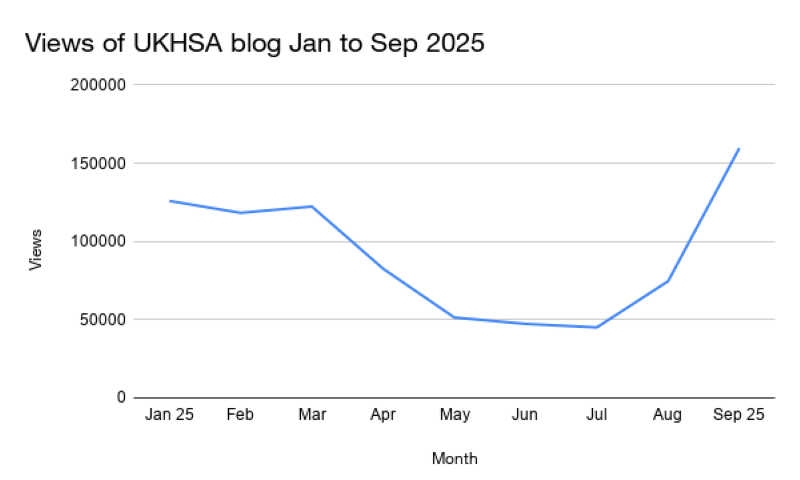
In spring 2025, UKHSA noticed a sharp decline in traffic to the UKHSA blog. This wasn’t a seasonal variation. Spring is typically a busy period for public health messaging, and the organisation had not seen a similar pattern in previous years. Colleagues in other government organisations had observed similar declines in their own content. This suggested the decrease might be related to Generative Engine Optimisation (GEO) and zero-click search.
Mis and disinformation are a particular challenge in public health communications. Sources such as the US Centers for Disease Control and Prevention, often achieve prominence in AI search results in the UK despite differing advice from UKHSA on some topics. This made it essential for UKHSA to address the blog’s declining visibility, given its role in providing trusted information on emerging and established health topics.
What they did
UKHSA researched GEO and began optimising its blog for AI search. It changed its post format to a question and answer style, and used tools such as Google Trends to mirror the language people use when searching. UKHSA also started monitoring social media more systematically, to see where relevant health topics were coming up in online conversations and narratives. It tested both updating existing posts and publishing new ones, to compare the effect on prominence. UKHSA reviewed performance daily through Google Analytics 4 (GA4) and by checking its prominence in AI overviews.
This wasn’t without challenges. Subject matter experts (SMEs) were sometimes hesitant to answer questions from online sources. There was also concern that answering queries could be counterproductive. UKHSA has often been successful in using evidence-based approaches to show stakeholders that their content meets genuine user needs. However, this requires ongoing effort given UKHSA’s broad remit and the wide range of SMEs it works with.
UKHSA also saw concern amongst wider stakeholders about including terms that people are actively searching for that are not scientifically accurate, such as last winter’s ‘super flu’. To mitigate this, their approach was to caveat such terms as ‘so-called’, framing them explicitly as media language rather than scientific or clinical terminology.
The outcome
This approach led to an immediate rise in the prominence of UKHSA content in AI overviews and standard search results, from the time-limited MenB vaccine to solar eclipse viewing safety advice. UKHSA now regularly reports on AI citation as one of their key metrics. Over the past year, the UKHSA blog received more than 3.3 million views, an increase of over 160% year on year.
Next steps
UKHSA’s trialling of new approaches suggests AI search favours entirely new content over a stable, canonical source, unlike traditional SEO. This means the team regularly revisit existing content, which is as important as producing new material. It’s equally important to archive outdated material, so it does not resurface in AI overviews.