
Communications and citizen participation toolkit
Practical guidance to help government communicators play a meaningful role in citizen participation – building public trust through transparent, inclusive and effective engagement.
Contents:
- Introduction
- Executive summary
- What is citizen participation?
- Why use communications in citizen participation?
- Taking a multi-disciplinary approach to communications
- Effective communications for citizen participation a step-by-step guide to implementation
- How to apply this guide
- Case studies: The power of citizen participation
- Annexes
- Acknowledgements
Introduction
As governments around the world are challenged with solving society’s most complex problems, gathering inputs from citizens has moved from being a ‘nice-to-have’ to a necessity. Today’s information environment presents both a challenge and an opportunity. Citizens are navigating an ever-evolving media landscape and trust in public institutions has declined. Yet, this same environment enables governments and their organisations to listen at scale, engage in real time, and build more transparent, responsive relationships with the people they serve.
Strengthening trust requires not only good policy but also a new way of creating it that is responsive, inclusive, and reflects the needs and concerns of the public.
By engaging citizens early and meaningfully, public organisations can make better-informed choices, prioritise more effectively, gain legitimacy for difficult trade-offs, and foster understanding of why they take certain decisions. It also leads to better delivery of the services that shape their lives.
The Public Communication Scan of the United Kingdom – Using Public Communication to Strengthen Democracy and Build Trust highlighted multiple opportunities for Government Communications to strengthen the feedback loop between government and citizens. This toolkit, produced by the Organisation for Economic Co-operation and Development (OECD) Innovative, Digital and Open Governance (INDIGO) Division in collaboration with UK Government Communications, has been created to help you as communicators play an increasingly significant role in enabling high-quality citizen participation. It brings together practical advice as well as national and international good practice.
Communicators from all disciplines have a unique role to play – not only in telling the story of participation but in helping to shape it from the start.
While designed with communicators in mind, this toolkit also supports anyone involved in a participatory process. It can help professionals across all disciplines understand the power of good communications to strengthen participation from the ground up.
We hope this guide empowers you to support a culture of participation by embedding these processes, ensuring that they are effective, enduring and impactful.
Executive summary
Governments around the world are embracing a more participatory way of working to address complex societal challenges and rebuild trust. Citizen participation is a means of involving the public in generating the evidence base used to shape policies and services and to communicate them effectively. Just as importantly, it signals responsiveness, builds support for difficult decisions, and helps to achieve more fair, effective, and sustainable outcomes.
As communicators, you will be aware of the diverse needs and perspectives of different groups in society. You are critical to ensuring that this engagement is meaningful and impactful from start to finish and you can add value at every stage of the process.
Communicators are essential for successful citizen participation
Effective communication is vital at every stage of the citizen participation process – from initial planning to providing post-engagement feedback. As communicators, you can play an important role in clarifying the objectives, applying audience insights, supporting event logistics, and ensuring that all interactions are transparent and credible. Crucially, effective communication can also promote public understanding of the issues at hand, and demonstrate how citizens’ inputs are reflected in government decisions after a participatory process has taken place.
Policy and communications must work hand-in-hand as a team
Building a culture of participation requires close collaboration across disciplines. As a communicator, you offer valuable skills, including public engagement, storytelling, risk management, and creative design, all of which are instrumental in shaping, supporting, and strengthening the participatory process. Embedding these approaches into everyday government practice, treating each project as a learning experience, and working closely together as a multidisciplinary team will build your organisation’s capability. This unlocks the potential of citizen participation to improve policy outcomes and build trust over time.
Communicators bring a wealth of relevant skills
Communicators bring many of the skills needed for successful citizen participation. While some will be familiar to you from your day-to-day communications work, others represent the opportunity to translate your existing expertise to a new context. With training and practice, you can build on your existing experience and enhance both the process of participation and its impact.
Digital technologies are reshaping how we communicate with and involve citizens. People consume information in more ways than ever before. To reach them effectively, we need to use the right platforms and channels – not just to deliver government messages, but to raise awareness of participation opportunities and encourage involvement.
What is citizen participation?
Citizen participation gives members of the public the opportunity to offer insights, set priorities, share feedback, generate recommendations and give options for compromises. This input has the power to improve policy outcomes and help governments and public organisations to make informed and tough decisions.
There are many ways in which the public can be involved, ranging from listening to consulting to actively collaborating with them. Certain methods of participation can even empower citizens to have the final say on decisions, for example, how a portion of the local budget is used within their communities.
When should citizens be involved?
Understanding what you want to get from participation is a key consideration in determining when, where and how to involve people. The rationale for participation differs at each stage.
Citizens can be involved at any point in the policy cycle:
- Agenda setting to identify priorities for policies and services
- Policy formulation to explore options and influence decisions
- Policy adoption to decide on which option to take forward
- Implementation to test solutions and refine policies and services
- Monitoring and evaluation to ensure accountability and identify areas for improvement.
What does citizen participation look like?
Citizen, or public, participation is a growing field, with a range of methodologies that suit different types of problems, budgets, and needs. Each methodology differs in the level of influence that participants can have. Some are better suited to early-stage involvement, while others work best later in the policy cycle.
Citizen involvement happens at different levels
Citizen participation happens at different levels – from informing and listening to consulting, collaborating and, ultimately, empowering citizens. ‘Listening’ involves gathering and analysing citizens’ perspectives. ‘Consultation’ actively seeks their feedback, while ‘Collaboration’ means working together to co-create solutions. ‘Empowerment’ gives citizens decision-making responsibility, such as through participatory budgeting.
The pyramid below illustrates these varying degrees of participation and highlights the importance of tailoring methods to the desired extent of involvement. You should be aware that projects do not necessarily pass through all levels of involvement, starting at the bottom and making their way up to the top. Sometimes, ‘Listening’ and ‘Consulting’ will be enough to inform the decision that needs to be taken; conversely, there may already be a bank of insight that is compelling and clear enough to enable a project team to move straight to ‘Collaborating’ or ‘Empowering’.
The Pyramid of Participation
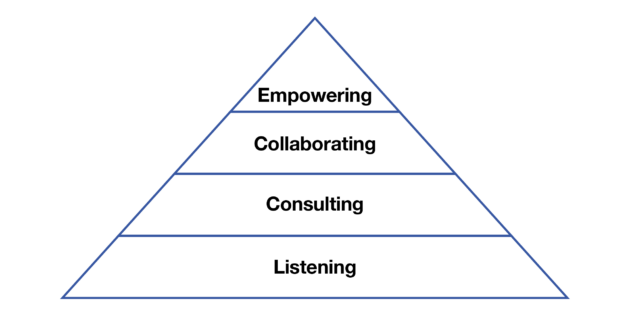
The Pyramid of Participation is based on the OECD ladder of participation, drawn from the OECD Recommendation of the Council on Open Government.
The pyramid includes four levels:
- Listening – Government gathers insights from citizens
- Consulting – Government actively seeks feedback from citizens
- Collaborating – Government meaningfully works with citizens to co-identify and co-create solutions
- Empowering – Government empowers citizens to take decisions
Common forms of citizen participation
Here is an overview of some common forms of citizen participation. You should be aware that the field is continually evolving and there is always room for experimentation, adaptation and innovation.
- Open meetings: Gathering citizens in face-to-face meetings with public officials to provide information and discuss specific topics of interest with them.
- Public consultations: An exchange whereby participants share feedback with public officials, including comments, perceptions, information, advice, experiences, and ideas
- Roundtables and focus groups: Speaking directly with individuals or communities who may have specific expertise on a subject area or who may be particularly affected by a policy or service.
- National and local dialogues: Enabling the public to engage in meaningful conversations on pressing societal issues over a time period longer than a roundtable or focus group.
- Citizens’ assemblies, panels and juries: Engaging members of the public in a scientific or evidence-based investigation, allowing for collaboration and co-creation.
- Citizen science: A randomly selected, broadly representative, group of citizens are invited to engage in deliberation, dedicating time to learning and collaborating to develop and agree upon collective recommendations.
- Deliberative polling: Gathering a representative sample of citizens to deliberate on specific issues, surveying their views before and after the process
- Participatory budgeting: Citizens are given the opportunity to directly influence budget decisions by voting on the allocation of public resources towards projects. It most often takes place at the local level.
- Crowdsourcing and hackathons: Enabling citizens to leverage their collective intelligence to gather ideas and co-create solutions to specific challenges.
- Civic monitoring: Directly involving citizens in the monitoring and evaluation of public decisions, policies, and services. An example could be community oversight on a specific project or service.
How do you choose the right participation method?
Successful participatory processes require careful planning and delivery to ensure meaningful outcomes. You will need to consider what you are trying to achieve, whose input you need to achieve this, how you will know if you are on target and what to look out for and adjust along the way.
Consider your objective
Be clear about the issue at hand. Every successful engagement begins with a clear understanding of why you are doing it. Define the issue in plain terms and be explicit about what you hope to achieve. Are you seeking fresh ideas, building consensus, or testing policy or service design options? Your objective will shape the approach.
Choose methods that are a good fit with your goal. Different methods serve different purposes. If you need broad input quickly, online surveys or open calls may work best. Consider workshops or focus groups if the aim is in-depth discussion. For extended exploration and input over a period of time, consider deliberative methods such as citizens’ panels or assemblies. Use deliberative polling or structured dialogues when you want informed opinions after participants have had time to learn about the topic.
Decide who you want to include
Think through who can bring the perspectives you need. Representation matters. Map out stakeholders and communities affected by the issue. Ask, who holds relevant expertise? Who brings lived experience? Who is often left out? Designing outreach so that diverse voices can participate meaningfully may mean adjusting timing, language or format to remove barriers.
Random selection, or “sortition”, is appropriate for projects that require a representative sample of the population, such as citizens’ assemblies or panels. When exploring themes with a particular group, such as youth, marginalised communities or businesses, you will need to target and recruit these explicitly.
Bake in evaluation from the start
Equally important is deciding on how to create the space for reflection and evaluation. Collecting feedback from participants during the process allows you to understand what worked well and what can be improved. Participatory processes are dynamic and evolving, and continuous learning helps to improve how they are done so that future engagements are more inclusive, effective, and impactful.
In-house or outsourced?
Consider the level of skills available in-house
Many citizen participation activities, especially those that are smaller in scale or less technically complex, can be successfully led in-house. This allows you to maintain closer control over the process, ensure alignment with your objectives, and facilitate more direct engagement with participants. With training and practice, in-house teams can lead activities such as open meetings, dialogues, hackathons, or participatory budgeting. This can be very helpful when budgets are constrained.
Organisations specialised in facilitating citizen participation processes can bring specific skills and experience that may not be readily available in-house. These can include research companies, consultancy firms, civil society organisations, academic institutions or specialised contractors with a proven track record in conducting participatory processes.
Consider your resources and capacity
Some large-scale and complex processes, for example, citizens’ assemblies, may particularly benefit from commissioning an expert external provider to manage the process from beginning to end in order to ensure objectivity, fairness, and transparency. Depending on the budget available, an independent third-party provider can manage logistics, facilitate discussions, and ensure that the process runs smoothly at all stages.
Consider the sensitivity of the topic
Some participatory processes, especially those that touch on sensitive or highly divisive issues, may be best conducted at arm’s length by independent third parties. Their role can be crucial when the scale, complexity or sensitivity of the process demands an external perspective or very specific expertise. An external provider can offer impartiality, ensuring that the process is seen as unbiased and not influenced by political or organisational pressures.
Why use communications in citizen participation?
Listening to, consulting and involving the public in policy making – and in the design and delivery of services – is not just beneficial, it is essential. It demonstrates a clear commitment to putting citizens at the heart of government and can lead to better outcomes for all of society.
Whether the issue is housing, climate, education, or healthcare, people’s valuable lived experiences and perspectives can help governments identify real priorities and decide what to spend public money on. As a communicator, you understand this well. Plugged into the latest audience insights, communicators are often the people best positioned to share public attitudes and concerns with decision makers. This makes communications a crucial ingredient in the successful participation of citizens in decisions that affect their lives.
Greater citizen participation helps build trust in government
The active involvement of citizens in considering evidence, testing ideas and co-creating solutions can help tackle divisive issues, develop better policies and increase public support for decisions made. This builds trust by fostering a sense of ownership among communities and ensuring that policies reflect the needs and priorities of those they affect.
Low trust undermines the effectiveness of what government does, whether creating policies and services or communicating with the public. As in many countries, British citizens’ trust in their public institutions has been declining: 57% of UK respondents in the OECD Trust Survey indicated that they have low or no trust in their national government.
However, public trust is higher among individuals who feel they have a say in government decisions
The OECD Trust Survey of 30 countries shows that perceptions of having a say has a greater influence on trust than characteristics like age, gender, income, and education. Only 20% of UK respondents believe that the political system allows people like them to have a say in what government does. Those who believe they have a say are far more likely to trust their national government. Among this group, 57% say they trust government, compared to just 17% of those who do not feel they have a say.
Why are good communications so important?
Communicating transparently and effectively with the public whenever you are conducting a citizen participation process has a fundamental role to play in building trust. It can help cement public perception that policy decisions are based on evidence, that citizens have a say in government decisions and that the government acts on feedback. All of these have been identified as important drivers of public trust[1].
Good and timely communications can:
- Attract potential participants and promote the opportunities to shape public policy
- Help participants and the wider public to engage with the relevant policy issue or question
- Ensure the process, its outcomes and policy decisions based on it are perceived as legitimate by the public
- Pre-empt any risks that may arise from misconceptions or misinformation about the process
Internal communications matter too. Civil servants across government and the wider public sector are increasingly working together to develop the expertise and skills needed to involve citizens more effectively, with the aim of fostering a culture of participation. Good communication within and across teams and organisations is therefore essential, not only to support this learning process, but also to enable the sharing of good practice and experience.
Is citizen participation the same as stakeholder participation?
Citizen participation is defined by the OECD as “all the ways in which stakeholders (including citizens) can be involved in the policy cycle and in service design and delivery”. This area of policy practice is growing rapidly around the world.
Why focus on citizens rather than stakeholders? Citizen and stakeholder participation are not mutually exclusive, although sometimes it can be difficult to tell the difference between the two.
Stakeholders are often involved in policy issues as part of their core role and may therefore need less support to bring on board. Citizens, on the other hand, are not usually involved in policy making as part of their day-to-day life. As a result, they often need more information, time and guidance to participate meaningfully.
Both groups can and do bring valuable perspectives. Stakeholders often contribute through expert panels or advisory groups, while citizens have traditionally engaged through public consultations, roundtables, and open meetings. Each approach has its place, depending on the objective. Whichever group you are working with, participants must understand how their input will link to decision making. This connection between the participation process and the decisions taken by government is critical[2].
- Citizens: Individuals, regardless of their age, gender, sexual orientation, religious, and political affiliations. The term is meant in the larger sense of ‘an inhabitant of a particular place’, which can be in reference to a village, town, city, region, state, or country, depending on the context. It is not meant in the more restrictive sense of ‘a legally recognised national of a state’.
- Stakeholders: An organised or professionalised group that represents a specific interest in public life. This includes associations, civil society organisations, academia, the media, and the private sector, among others. Stakeholders typically have a defined mandate, structure, or expertise that enables them to contribute to policy discussions on behalf of a broader group or issue area.
How can communicators make a difference to citizen participation?
Communications are an essential part of engagement with the public. Effective communications should enable a continuous dialogue between government and citizens, whether or not they are called to participate in a given policy or decision. Every day, communicators work to explain the policies and actions of the government to people. However, communications can go much further still.
As a communicator, you can bring unique skills and experience to citizen participation in several ways.
- Actively conducting social listening: using the insights that communications teams gather from systematic and comprehensive listening across information channels, and keeping leaders and other relevant internal stakeholders informed about what the public is thinking.
- Working with other disciplines to design the participation process: reaching out to policy and other relevant colleagues to support them in defining the specific problem and designing the activities through examining evidence and insight from citizens and stakeholders.
- Providing communications expertise to assist with implementation: leveraging communicators’ skills and competencies to support the delivery of different elements of citizen participation. This includes using creative and digital skills to bring evidence and ideas to life, as well as lending event management expertise to ensure that all activities run smoothly.
- Communicating with participants and the wider public: ensuring effective communications with both the participants and the wider public to foster constructive debate about the policy question at hand. This includes addressing misconceptions and ensuring that both participants and citizens perceive the process and its outcomes as legitimate.
- Using findings to deliver effective communications: using what is learnt from citizens to identify the information that each audience group needs to make better, more informed choices and to participate in public life, enabling these insights to be included in communications planning going forward.
- Closing the feedback loop: through citizen participation, government communication can contribute to a feedback loop between citizens and institutions[3]. This two-way dialogue enables government to be more transparent and responsive to the public, even during periods when there is no direct opportunity for citizens to participate in policy making[4].
Reimagining communication and participation in the digital age
Where and how people access information is changing
Emerging technologies and digital platforms are reshaping how people consume and access information. In the UK, 71% of adults now access their news online, with online intermediaries used by 60% of adults[5]. And in a world where social media platforms are overtaking traditional news outlets as sources of information, governments need to reach citizens and connect with them where they are and in a way that resonates with them.
Digital platforms and technologies can increase participation and enhance the process
Citizens are already on channels such as social media, messaging apps and interactive platforms that can be used effectively to promote participation opportunities in an engaging way. Social media allows organisations to reach wider and more diverse audiences, enabling engagement with people in spaces they already use. It provides cost effective opportunities throughout all consultation stages, from pre-consultation stakeholder mapping and warming up of communities, through live monitoring and myth-busting during the participation phase, to post-consultation feedback and sentiment analysis. Local authorities have been increasingly adopting this as an engagement mechanism in recent years. A growing number of platforms specifically designed for use in participation processes are also emerging, enabling wide geographical reach and rapid response and analysis.
AI tools can also be used to enhance the experience of participation sessions. Many city authorities have experimented with virtual reality simulations to let residents “walk through” proposed urban redevelopment projects before decisions are made[6]. This can make abstract proposals and plans more tangible, helping citizens provide informed feedback and encouraging empathy with different stakeholder perspectives.
Take an integrated approach to ensure inclusion
While digital platforms increase accessibility for many, they risk excluding those without reliable technology access, so they must complement traditional methods rather than replace them. To ensure genuine inclusion, participation teams should provide alternatives alongside each digital component, such as mailings, community notice board flyers, in-person submission mechanisms, and physical voting stations in frequently visited locations[7]. Partnering with civil society organisations representing vulnerable or underrepresented groups can also extend reach through their networks and gain insights into which approaches will be most effective for their communities.
Taking a multi‑disciplinary approach to communications
Working together as a participation team
Participatory processes are most commonly led by policy teams. However, this is not always the case and responsibility may lie with other areas such as service delivery. There is a link between the stage of the policy cycle an initiative corresponds to and where organisational ownership may lie, with policy playing a leading role in owning issues that define problems whereas other functions such as service delivery or digital may lead the design of practical solutions.
This is an established lens through which to view this distinction.
- Understand the problem: Discover and define
- Design the solution: Develop and deliver
A true culture of participation involves citizens at every stage, throughout both policy and service design and delivery.
Issues owned by policy: Policy teams handle high-level, systemic, and often unstructured problems, focusing on the “what” and “why” through strategy development, legislation, and broad objectives. Policy problems are typically long-term, complex, and involve the entire ecosystem of government objectives. They often require balancing competing priorities, managing political considerations, and creating legislative frameworks.
Issues owned by service delivery: Service delivery teams address concrete, operational issues related to the “how,” focusing on the day-to-day execution and user experience of a specific service. Service delivery problems are more concrete and operational, involving the direct interaction with citizens to provide a specific outcome, service, or information. The focus is on efficiency, accessibility, user experience and satisfaction, and effective implementation of policy.
When should communications be involved?
As a communicator, you play an important part in enabling your organisation to deliver better citizen participation. Communications can add value throughout a citizen participation process, from the early stages of inception to explaining how the results will shape policy or service design and delivery.
The exact shape of your support will vary depending on the type of process and the level of specialist skills within your team. These could include expertise in audience insight and segmentation, plain language and storytelling techniques, content creation, multi-channel outreach, or framing policy issues and opportunities to participate in ways that resonate with the public.
If you are involved in a participation project you should ensure that you have up-to-date knowledge of the policy area in question so that you can contribute the right insights and successfully craft the narrative around participation.
Building strong working relationships
Participation processes are most effective when they involve a multidisciplinary project team that includes both policy and communications. Whether your department or organisation is well-versed in citizen participation or is taking its first steps, more can be achieved by working collaboratively. Joint planning and commitment are needed to ensure shared objectives, reduce possible duplication and improve efficiency.
Teams considering citizen participation should engage with communications as early as possible but they may not be aware of what you as a communicator can offer. You should be proactive in reaching out and building strong working relationships with policy or participation teams from the get-go.
When to lead
You should lead on acting as an interface between government, participants, key stakeholders, and the wider public, ensuring timely and relevant two-way communication. This builds awareness and buy-in for the process and its outcomes, ensuring its legitimacy while fostering constructive public debate. Communicators should also lead the messaging activity in relation to how participants’ inputs are used.
You should support policy
You should support policy teams when they are in the process of considering or planning a participation process. Your input into the preliminary analysis of insight that informs choices about focus, scope, and methods can help to ensure that both the design and implementation of the process are well thought through.
Making citizen participation routine
Over time, citizen participation has the potential to become a routine and valued part of a government’s approach to gathering evidence and solving problems. Until then, sharing knowledge, experimenting and innovating, learning from past experiences, and building on each effort – large or small – will be essential to grow practitioners’ confidence in this area. Each participatory process contributes to developing and embedding a culture of participation within government and society.
You should:
- Be proactive in seeking opportunities to be involved in and, where appropriate, lead participatory activities
- Learn by doing, drawing insights from each initiative to help build institutional knowledge
- Connect with colleagues across the public sector, including through communities of practice such as the Cross-Governmental Participatory Methods Forum
- Act as champions of citizen participation within your department or organisation, advising colleagues, supporting senior leaders, and promoting its value
- Ask yourself which teams within your organisation should receive the insights gathered
Effective communications for citizen participation
A step-by-step guide to implementation
This section is designed as a practical guide for communicators who want to strengthen citizen participation through effective communications. It breaks the process down into clear steps, from using audience insights to closing the feedback loop, so you can see where and how communications add value at every stage.
Use it as a reference guide when planning or supporting a participatory process: follow the steps in sequence for a comprehensive approach or select the ones most relevant to your role and context. Each step includes key considerations and actions to help you demonstrate transparency, build trust and make participation impactful.
Preparation
The team identifies the problem to be solved, outlines the objectives and expectations, and decides who to involve and the methodology to use.
- Step 1: Use any relevant existing audience and stakeholder insight to help the team consider where participation could add value
- Step 2: Analyse public and stakeholder positions to support with designing and selecting the participation process
- Step 3: Identify who should be involved and who should be informed
Before
The team lays the groundwork for an effective citizen participation process, including recruiting individuals to take part, organising events and venues, and preparing materials for the discussions.
- Step 4: Support effective recruitment of and engagement with participants
- Step 5: Assist with organising the event or series of events
- Step 6: Contribute to stimulus materials for the discussions with participants
During
Participants need to know what they are taking part in, why, where and when, and what to expect at all stages of the process. Depending on the issue, the wider public may also need to be informed or engaged.
- Step 7: Announce and promote the participation process
- Step 8: Communicate during the process, bringing the exercise to life and fostering public debate
After
After the participatory activity has taken place, the outcomes of the process and any impact should be communicated both internally and externally. Evaluating and sharing information with other teams helps to ensure continuous improvement across government.
- Step 9: Communicate the insights and recommendations made by participants
- Step 10: Close the loop by communicating how citizens’ inputs are being used by government
Step 1: Use existing audience and stakeholder insights to identify where participation could be valuable
Audience insights should serve as the foundation for every participatory process. This allows government to stay tuned to what people care about now — and what they are likely to care about in the future.
Communicators can play a role in enriching the sources of information available to the organisation. If you are working in an insight related role, you will be adept at monitoring public sentiment and collecting feedback from citizens and stakeholders. You will also be skilled at recognising when citizens should be engaged on a particular issue. In the early stages, before a project even begins, audience insights can help you identify where participation may be useful, which you can bring to an initial conversation with colleagues working in the relevant policy area.
You should:
- Identify existing secondary data, such as social listening and media monitoring outputs
- Gather any formal or informal sources of public feedback, for example, focus groups and surveys
- Ask yourself which teams within your organisation should receive these insights
Once you have gathered and analysed the relevant insights, you will have a clearer picture of where and how participation could be helpful. This will enable you and your colleagues to decide on and structure a process that reflects the richness of the debate and the diversity of perspectives.
Step 2: Analyse the positions of citizens and stakeholders to help structure the participation process
Once your organisation has decided to conduct a participatory process on a particular issue, as a communicator, you can assist policy colleagues with getting a clearer picture of the problem at hand. This includes identifying who is affected and understanding the range of views on the issue.
Using the audience and stakeholder insights that you have gathered on the topic can help build the case for using citizen participation and can also inform the design of the participatory process itself. As you take your colleagues through the evidence, it is important to consider others’ perspectives, which may vary depending on their area of expertise.
At this stage, you will also want to understand the perspectives of stakeholders outside of government, such as civil society organisations and interest groups, before deciding whether to engage them in the process itself. Research what stakeholders have said in the media, online or in publications.
This insight can assist the team in choosing a method of participation and in deciding at which stage of the policy cycle to engage these stakeholders.
Ask yourself:
- What is the scope of the problem?
- Do we need to test policy options, or generate different options entirely, or find a compromise?
- What are the gaps in our understanding of public positions?
- What specific question(s) do we need citizens to address?
- What are the main positions currently held by the public and by stakeholders on the issue(s)?
- What are the trade-offs between different positions on the issue? What is the scope for compromise?
Step 3: Identify who to inform and who to involve
With the policy problem now defined, communicators can use their insights to consider who is interested in or affected by the issue – and who should be involved. At this stage, you should be able to identify the key voices on the subject, for example, community or sector leaders, who could support with outreach and awareness in relation to the participation process. You should also be conscious of voices that may disrupt or obstruct the process and think of how they can be brought on board.
This analysis can help determine the scale of the process and the number of participants to involve, especially when budgetary or time constraints demand a narrower scope.
The key considerations when mapping these different stakeholders are:
- Who is affected by the policy problem, directly or indirectly?
- What kind of budget is available for the process? How will this affect your methodology?
- Which groups need to be involved for all relevant perspectives to be represented?
- Which citizens or stakeholders need to be informed about the process, and which need to be directly involved as participants?
- Do you intend to represent the entire population, or specific demographics or communities?
- Should the process be open call or by invitation only?
Step 4: Support effective interactions with participants
Communicating with participants differs from communicating with the general public. Communication with participants involves giving day-to-day direction and support throughout the process while gathering feedback on an ongoing basis. Communication with the general public aims to raise awareness about the participatory process, any key moments, and overall outcomes once it is finished. Read the OECD Guidelines for Citizen Participation Processes for more information.
If the participation process is being managed in-house, you will need to ensure that all communications with prospective participants are clear, accessible and encourage people to take part. This includes creating a sense of psychological safety – for example, by reassuring participants that taking part or expressing their views will not affect their access to public services or support in any way.
The extent to which you get involved in this phase will vary considerably depending on the participation methodology chosen and the degree to which external suppliers are involved. Contracted external suppliers will likely manage several steps of the process, particularly recruitment, organising events, and stimulus preparation, but working closely with them to enhance the richness and accessibility of information that is provided to participants and the public is important.
Liaising effectively with participants at every stage – whether before, during, or after an event – will give them clarity, keep them motivated, and maintain trust.
How participants are recruited depends on the type of process. Some, such as deliberative assemblies and panels, recruit participants through random selection. Others target specific profiles whose lived experience is essential for informing policy. And lastly, some processes recruit widely, where the challenge is often to attract numerous and diverse participants. Public consultations, town halls, dialogues, or participatory budgeting are open to all; however, they are most effective when participants go beyond the “usual suspects”; that is to say those who frequently take part but may not represent a broader demographic. Consider using a range of outreach channels to ensure broader engagement.
Communications with participants should:
- Clarify the process, its purpose and objectives, and how it will work
- Explain the value of their participation and how it can benefit them and their community
- Explain their role and what is expected of them, the timescales involved, and any incentives (monetary or in-kind)
- Provide practical information about logistics and about how to prepare for taking part
Step 5: Assist with organising events and gatherings
Once the participatory method has been chosen, planning for the event or series of events begins. If you have skills and experience in stakeholder engagement or events management, you will be well placed to support activities where participants come together to take part in discussions, whether in person or virtually.
Make sure you have enough facilitators so all participants can contribute actively and stay on topic. Typically, six to eight people per facilitator works well for most processes, though more complex discussions may need a lower ratio. Facilitators should remain neutral and support the group without steering the conversation to avoid bias.
If there will be any photography or publicity around the events, you should inform participants beforehand and obtain their consent to share their names or images. Additionally, if an event is open to the general public, you should have a plan for how to manage any participants who may obstruct or disrupt the process.
Ask yourself:
- Where in the process will the event or series of events take place? How will each contribute to the overall objectives?
- Which formats and locations will best ensure meaningful participation?
- What should the moderation guide include to ensure smooth facilitation, including details of the time needed for showing stimulus, discussion, and reporting back?
- Are breakout groups or separate spaces needed for specific parts of the process?
- How will progress be communicated during longer or multi-event processes?
- What is the plan for updating participants and the public on outcomes and how citizen input will inform government decisions?
Step 6: Enhance stimulus for discussions
Presenting information in a clear, engaging, and accessible way is a key communications skill. The information underpinning the stimulus is best selected by policy teams as subject experts, but as a communicator, you can bring it to life. This is particularly important when participants do not have lived experience of the subject matter.
You could consider using multimedia content such as videos to make evidence and stimulus materials more tangible for participants. This might include creating real, hypothetical or predicted scenarios, for example, illustrating what the world could look like at different degrees of warming. If you do not have in-house content capability but budget permits, you could collaborate with a creative agency to help with production.
When preparing stimulus materials, it is important to remain neutral and avoid any biased framing of viewpoints or evidence.
Stimulus materials should be:
- Objective and unbiased
- Engaging and digestible
- Comprehensive without being too long
- Clear and accessible to all, especially in the case of complex or technical topics
Step 7: Announce the process
Once you know what will be taking place and when, the next step is to announce the citizen participation activity. The announcement should build awareness and momentum and stimulate constructive debate about the issue. It should also clearly convey the purpose of the initiative, highlighting the expectations and outcomes.
At this stage, you could consider planning a range of media activities, depending on the scale of the process. Featuring a high-level official or politician as a spokesperson can add weight and credibility to the process, signalling a strong commitment. However, political involvement may also polarise opinion and have adverse effects on some audiences’ perceptions. This decision should be weighed up carefully on a case-by-case basis.
When engaging with the wider public, the goal is to raise awareness and improve understanding of the participatory process, the issues it addresses, and how it functions. You may want to include dedicated webpages, livestreams, social media, press releases, conferences, and engagement with stakeholders or experts.
When a participation process involves an open call to the broader public, you will need to tell people at the right time how they can get involved. You can use existing platforms to raise awareness and promote sign-ups, for example, through GOV.UK, or you may want to create a bespoke platform for this process (read the section on case studies for examples).
Setting the right expectations is key to mitigating reputational risks:
- Be clear about the expected results. Will citizens be asked to share their views or to develop concrete recommendations? Will the insights gathered inform a specific policy or strategy? How will the government respond to the inputs?
- Stress that the final decisions rest with elected representatives
- Motivate people to participate in or follow the process while avoiding over promising
- Pre-empt common misconceptions and scepticism about citizen participation such as who should and should not participate, whether the process is fair, or whether it will have any impact
Step 8: Bring the process to life and foster public debate
Communicating effectively throughout a process can raise awareness and promote legitimacy. Transparency about the process also plays a crucial role in fostering a culture of participation across society. In a participatory process, especially a large-scale one like a Citizens’ Assembly, it is important that participants take centre stage. However, if you decide to invite participants to become spokespeople around the process, it is crucial to assess the risks they may face, such as online abuse or other threats, especially when the topics involved are particularly sensitive and what media training you may need to put in place (read Step 9).
Think about how you can keep your audience updated during all phases of the process by:
- Developing a comprehensive multi-channel communication strategy, for example, dedicated webpages or platforms, livestreams, social media, press releases and conferences
- Opening the door to media and journalists to witness the process
- Providing support for individual participants to act as ambassadors for the process
- Creating content that explains and summarises process milestones
- Promoting calls to action during processes that require citizens to pitch ideas or vote on proposals
Step 9: Communicate the insights and recommendations generated by participants
Now that the participatory process has taken place, you need to give visibility to the insights gathered and the recommendations made by participants. It is good practice to publish what people have said, even if this is in advance of the government deciding how it will use these inputs.
Remember that participants can be compelling spokespeople when it comes to sharing the outcomes of the process. To manage risks, you should arrange a proper briefing and training before any media involvement.
Ideally, the same person who announced the process on behalf of the government should announce the results, particularly when a senior-level spokesperson has been involved. Make sure, therefore, that you remain engaged with this person throughout the process.
When communicating the results:
- Distil clear and simple messages from the outcomes without altering the meaning or wording of participants.
- Inform participants about the results and about how their input has been received so that they do not hear things only after they have been made public.
- Share findings with the public, adjusting the level of detail depending on the process. For example, with a citizen assembly, it is good practice to share the recommendations in full whereas following a public consultation, a summary of inputs could suffice.
- Consider using AI to collate and summarise large volumes of feedback but always check any outputs for accuracy.
- Provide clarity about what happens next and when the results will be considered by decision makers.
Step 10: Close the loop by communicating how citizens’ inputs are used
For communicators, closing the loop, that is to say, feeding back to the public, is the most important step. It carries the greatest reputational risks for your organisation as you need to demonstrate that you have listened to citizens. In that sense, it also carries the greatest dividends for public trust. Citizen inputs may shape policy: they can be used fully or in part and in some cases, they are not used, but the results generated add to a valuable bank of insight.
You must be prepared to report back to the participants and public regardless of the decisions taken. Reporting back aims to pre-empt public scepticism about whether their feedback is meaningfully considered or leads to tangible changes. Failing to close the feedback loop risks discrediting the process, discouraging future involvement and undermining trust in government.
Visible progress on a policy that uses citizens’ inputs can take a long time. Consider communicating any intermediate steps of policy making to avoid leaving citizens in the dark.
When communicating how inputs are used – or not used:
- Explain what inputs were received and how they were considered
- Emphasise which inputs directly influenced the decision-making process and clarify whether they were used directly or indirectly in developing policies, strategies or programmes
- Where appropriate, explain why inputs were not incorporated, for example, due to policy constraints, budget limitations, or legal factors, and mention what actions were taken instead
- If inputs were used, highlight the value of the participation process, and bring participants back to comment on the impact their contributions had
- Ensure the public and participants understand what will happen next and stress the value of citizen participation in shaping policies, strategies or programmes
- Prepare to manage potential criticism and any backlash on the responsiveness of government to the feedback from the participants
How to build trust around communication in citizen participation
Set expectations
Citizens and policy makers should be given realistic expectations about what scope there is for government and public organisations to take on board the results of the process and to what extent.
Ensure independence
Communication around the process should be careful to avoid biasing policy making decisions. In some cases, communication with the public may be limited to before and after the process itself.
Close the feedback loop
Communication should ensure that everyone who participated in and followed the process is informed about how citizens’ inputs were used.
Empower citizens as spokespeople
Citizens and participants themselves can be the best ambassadors for any process. Leveraging their voices to connect with their own communities and peers is a powerful means to bring a participation process to life.
Be crisis ready
Communicators should always be prepared to act in the event of a crisis that threatens the integrity and credibility of a process. Examples include mis- and disinformation about the process and third party statements that could discredit it.
Avoiding common pitfalls
To reap the benefits of citizen participation, you should be aware of common pitfalls. These include tokenistic consultation, insufficient follow-up, and a lack of accessibility, as well as risks of misperceptions or misinformation about the process. Instead, prioritise transparency, communication, and genuine opportunities for influence to ensure that participation leads to tangible impacts.
Do
- Set clear expectations from the outset.
- Provide consistent messaging around the value of participation.
- Experiment with methods and adapt the process to needs.
- Consider using digital tools and novel channels to expand reach.
- Bring in senior officials to signal the importance of the process.
- Consider the viewpoints of diverse stakeholders, opinion leaders, and groups.
- Consider accessibility and inclusion in the design of the process.
- Communicate key milestones throughout the process.
- Support and empower willing participants to act as citizen spokespeople for the process.
- Provide feedback to participants and to the public.
Don’t
- Overpromise only to underdeliver at the end.
- Minimise or undervalue the contributions of citizens.
- Overlook potential digital divides.
- Take shortcuts that could undermine the integrity of the process.
- Forget to consider whether this could politicise or interfere with the process.
- Stick to listening to the “usual suspects” only. However, make sure that influential actors are engaged.
- Assume citizens are equipped to participate on an equal basis.
- Lose momentum in between announcing the beginning and end of the process.
- Forget to provide participants with the necessary protection and support to ensure their privacy and safety.
- Leave participants questioning what happened to their input.
How to apply this guide
The following scenarios are fictional and illustrate how the steps outlined in this guide could be applied to real-world situations. These scenarios are intended to provide inspiration and ideas for addressing specific challenges similar to the ones you may encounter; they are not presented as the only or best approach to handling the issues presented. Each example highlights a different method of citizen participation and offers insight into its practical implementation.
Scenario A: Citizens’ assembly on household energy
In this fictional scenario, a Citizens’ Assembly of 200 randomly selected participants deliberates on how to transition households to low-carbon heating solutions to support the net zero 2050 goal.
Problem to solve
In order to reach net zero by 2050, households will need to reduce their reliance on fossil fuels and move towards clean sources of energy.
In this scenario, citizens are asked how the government could deliver clean power by 2030 and how it could transition all households to low-carbon heating solutions such as heat pumps. The exercise will include considering the costs and benefits for individual households and the public purse.
Chosen participation method
A Citizens’ Assembly with 200 participants selected through a randomised “civic lottery”. A civic lottery will be used for selecting participants since household energy is an issue that is likely to impact population groups differently, and therefore needs to be representative. A Citizens’ Assembly has been chosen as the participation method as the deliberation involved will help produce informed recommendations that are grounded in reality, which is essential for a topic that is challenging, technically complex and politicised. The process is being supported by a commissioned social research company.
Apply the steps
- In this scenario, the policy problem has already been defined as it is part of an existing government commitment, as has the participation method. During the scoping phase the communications team contributes any additional insight it has to the project team’s analysis and planning.
- Working alongside the policy team, the communication team analyses public and stakeholder positions on the issue of household heating and related topics, such as climate consciousness, housing, and the cost of living. They also gather information via social listening, surveys and existing research.
- The communications team maps relevant stakeholders and opinion leaders across the sector, including energy providers, environmental organisations and consumer groups.
- An external agency manages the recruitment and communication with participants. The communications team reviews all content related to the civic lottery to ensure the process and intended outcomes are clear and that the messaging is positive, motivational and accessible.
- Ahead of the assembly, communicators work with the policy team to formulate the questions that will be posed to citizens on the topics of affordability and reducing carbon emissions. They also suggest opinion leaders who can offer different perspectives on key trade-offs.
- In-house designers develop multimedia content to illustrate the evidence provided on how domestic clean technology (for example, heat pumps) work, their environmental benefits and the costs involved.
- Before recruitment begins, the communications team prepares to launch the assembly. The minister takes part in a series of broadcast interviews and is supported by a multi-channel campaign to generate interest and public debate. The campaign messaging explains what a Citizens’ Assembly is and stresses that citizens’ recommendations will inform government decisions on how to proceed with clean household energy solutions.
- The communications team creates content on the assembly’s progress, offering participants an opportunity to give their impressions of the process. The team invites the media to watch sessions and interview participants. It also monitors reactions to the assembly and the evolution of the debate on heat pumps to address any misconceptions or misinformation.
- Once the assembly is over, the communications team summarises the recommendations and plans media outreach. This outreach includes content from participants on the value of being involved, as well as quotes from the minister. While AI is useful in collating the outputs from large-scale consultations, in this scenario – a small-scale Citizens’ Assembly with in-person meetings – the participants produce a list of recommendations at the end using their own language, so the communications team does not distil these further using AI. The policy and communications teams also collaborate to capture learnings from the assembly, which are shared internally to encourage high-level endorsement for similar processes in the future.
- A new strategy for achieving clean household energy by 2030 is announced. The communications team ensures that the strategy launch emphasises the importance of the Citizens’ Assembly process in its development. The minister launches the strategy with assembly participants who are invited to discuss the process, their role in shaping it and the value of participation.
Scenario B: Nationwide dialogue on community led policing
In this fictional scenario, a nationwide dialogue engages citizens through multiple in-person and virtual roundtables to explore ways to strengthen community-led policing, enhance public safety, and build trust between law enforcement and diverse communities.
Problem to solve
Policing is at the heart of ensuring the security of communities, but public confidence in law enforcement has declined in recent years. This participation project asks citizens to consider how community-led policing could be strengthened nationwide. It asks citizens how this can be done in a way that improves public safety, fosters trust between citizens and law enforcement, and ensures that local policing reflects the needs and concerns of diverse communities.
Chosen participation method
A national dialogue with three in-person roundtables held in different locations with up to 200 participants, and one virtual roundtable that is open to all.
Apply the steps
- The communications team analyses existing insight, including social listening, news coverage, relevant surveys and other feedback from citizens on police-community relations, the current state of policing, and prospects for more community-based priority-setting, monitoring, and evaluation. The team shares this analysis with the policy team to inform the development of the national dialogue.
- The policy and communications teams work together to identify any gaps in knowledge, with special attention paid to marginalised groups, including those at risk of exclusion and those with prior negative encounters with law enforcement.
- The communications team maps opinion leaders, community groups, law enforcement, civil society organisations, neighbourhood associations, academia and activists at the local and national level.
- The policy team uses this map to ensure engagement from key communities and demographics. The communications team engages these stakeholders to assist with outreach and promote participation within their networks. Insight specialists identify locations for the in-person events that provide a representative sample and reflect the on-the-ground realities of community-led policing.
- The team prepares a communications strategy for the dialogue, focusing on the moments most likely to generate media coverage, for example before and after each roundtable. Insight colleagues set out moderation guidelines for the in-person and virtual events to ensure inclusion and limit any disruptive behaviour.
- The communications team advises the policy team on the best form of stimulus to facilitate constructive engagement. Team members who have worked on previous policing campaigns provide context and background, share success stories about community led policing and explain potential challenges. Visual and interactive content is created by in-house designers to make complex policing issues more engaging and relatable. The team ensures all content is accessible. For the virtual roundtable, the communications team adapts the in-person stimulus to work in a virtual setting.
- The national dialogue is announced by a government spokesperson and a senior law enforcement official who publicly endorses it to signal its importance. In a joint interview, they emphasise that the roundtables are a safe and inclusive space for reflection, learning, and in-depth discussion on the future of policing.
- Once the process gets underway, the communications team shares updates on its website and on social media. The team manages expectations about the possible impact of the dialogue, stressing that while all views will be listened to and considered, not all suggestions will be implemented. Members of the communications team with facilitation skills moderate breakout discussions at the roundtables.
- Once the roundtables have concluded, the communications team shares the most popular suggestions or recommendations in an accessible format. They clarify how the inputs will be reviewed and provide a timeline for next steps. The Minister for Policing and the Commissioner joins to make a closing statement to participants that highlights the value of the dialogue and explains how the insights will shape future policies, strategies, and programmes.
- A subsequent five-year strategy on community-led policing is announced, informed by some of the findings from the dialogue. The communications team ensures that the role of citizen dialogue in the development of the strategy is highlighted. The communications team prepares a case study to share with other public institutions about the benefits of the process to ensure high-level commitment for similar activities in the future.
Scenario C: Crowdsourcing views on apprenticeships
In this fictional scenario, crowdsourcing is used to gather broad public input on improving apprenticeship programmes to better address workforce gaps and equip young people with relevant skills for a changing job market.
Policy problem to solve
Apprenticeships are an important way of building skills, opportunities, and growth for young people. However, current schemes could do more to address gaps in the workforce while equipping young adults with the necessary skills to succeed in a rapidly evolving job market.
Chosen participation method
Crowdsourcing is the practice of gathering ideas, content or expertise by inviting contributions from a large group of people, typically via the internet. It enables organisations to draw on a wide, diverse pool of skills and collective intelligence, rather than relying solely on in-house teams or traditional stakeholders.
Apply the steps
- The communications team works with policy colleagues to combine their existing insight on apprenticeships to help plan the discussions with young people and which sectors to focus on. Together, they form a participation project team to take the work forward.
- They map out the customer journey from the perspective of apprentices and employers and identify pain points, using existing evidence and insight. They decide on a small-scale regional crowdsourcing process, focusing on the current apprenticeship system in the engineering and manufacturing sectors.
- The team decides to join up with local authorities and attends schools and colleges to speak to students in the target age group to hear from those who might consider apprenticeships in the next two years.
- Insight specialists advise on the number and location of local authorities and colleges to target as well as student recruitment criteria in order to ensure as broad a demographic within the project constraints as possible.
- Insight specialists devise a discussion plan and format for the sessions. The communications team creates promotional material to be used by the schools and colleges to encourage attendance at the crowdsourcing sessions.
- As the focus is on drawing out ideas from participants, no formal stimulus is created in advance. The team procures and prepares the necessary equipment for conducting crowdsourcing workshops, including sufficient supplies of post-it notes, marker pens, paper, and flip charts for participants to record their ideas.
- Given the small scale of this process, the team decides not to announce it publicly; the communications team’s external affairs specialists engage with their stakeholders in the relevant local authority to promote uptake of the events.
- The sessions explore how apprenticeships are advertised and how the application process works. Following this initial engagement, the team refines its materials, questions and facilitation approach, including adding new stimulus on generative AI (as identified by early participants as a major opportunity for skills development). To reach a wider audience, the team further adapts its approach to include digital meet-ups, which are promoted on social media. By expanding the process, the team builds a richer picture of the obstacles to starting successful apprenticeship schemes, as well as potential opportunities to make the system more attractive.
- The team documents its process, outcomes and learnings, ensuring it shares findings with all the relevant internal teams. Communicators create messaging to thank stakeholders and participants for taking part and to let them know the next steps.
- The successful elements are incorporated into a larger dialogue about apprenticeships that looks at the entire policy area, including speaking to businesses.
Scenario D: Digital consultation on artificial intelligence (AI) and emerging technology in public services
In this fictional scenario, a fully digital public consultation is launched to gather views on the use of artificial intelligence (AI) and emerging technologies in public services including healthcare, education, welfare, and justice.
Problem to solve
The use of AI and emerging technologies in public services has the potential to improve efficiency, responsiveness, and cost-effectiveness. However, it also raises concerns around bias, transparency, and the fairness of decisions. Citizens are invited to share their perspectives on how these technologies are currently used and how they should be deployed in the future.
Chosen participation method
Digital public consultation, with the process supported by a platform provider that launches and administers the platform on behalf of the government.
Apply the steps
- The communications team reviews current insights from the public, drawing from sources such as social media, media coverage, relevant surveys and existing data on the topic to support the external provider in structuring the process.
- Together with colleagues working on AI policy, the communications team analyses the positions of citizens and other key stakeholders including AI and technology companies, start-ups and Subject Matter Experts working in GovTech and civic tech, civil society organisations working on digital rights and social justice, and AI and data ethics academics.
- The multidisciplinary team maps all relevant stakeholders and opinion leaders in this field. As the government has contracted an external company to launch and administer the platform, the company uses this mapping to decide which stakeholders could assist with outreach and promotion of the consultation.
- The communications team plays a supporting role in crafting the questions that are put to the public in the public consultation. They also provide support in testing whether the platform is accessible and user-friendly to all demographics.
- As the public consultation is online only, there are no in-person events and gatherings to organise. However, the communications team is on hand to support the external provider in moderating any discussions on the platform.
- The communications team supports the external company in developing any stimulus to be featured on the platform.
- When the government launches the platform, the communications team is heavily involved in promoting the consultation through a multi-channel approach, using both traditional and social media.
- The communications team continues to support the external company in sharing updates on the process with the wider public.
- The external company collects and analyses the results of the consultation and prepares a summary report. The company uses AI to organise and decipher large volumes of feedback but manually checks the outputs for accuracy. The communications team ensures that the content is coherent, accessible, and framed in a way that resonates with diverse audiences.
- The results of the process are announced to the public with remarks from spokespersons from the Department for Digital, Innovation and Technology. The results are integrated into ongoing policy development and future frameworks for the ethical and effective use of AI and emerging technologies in public services.
Case studies: The power of citizen participation
These case studies show how citizen participation has been used in practice across different countries and contexts. Each one explores the role communications played in making the process work.
Read the case studies:
- Scotland’s People’s Panel on COVID-19
- Ireland’s Citizens’ Assembly on abortion rights
- Camden’s Citizens’ Assembly on the evening and night time economy
- Southampton’s Citizens’ Assembly on climate and transport
- Finland’s National Dialogues
- France’s Grand Débat National
- Paris’s participatory budget
- Digital platforms and civic technologies for participation – the Netherlands, Spain and Portugal
Annexes
Annex 1 – Useful resources and further reading
General reading on citizen participation
- Knowledge base on citizen participation (Involve)
- Citizen’s White Paper (Demos UK)
- Enabling national initiatives to take democracy beyond elections (NewDemocracy and the UN Democracy Fund)
- Open Policymaking Playbook (The Govlab)
- Public Participation Pillars (International association of public participation)
- How to design and plan public engagement processes (What Works Scotland)
- Public Participation in Government in the Future (New Zealand)
- Community of Practice on Participatory and Deliberative Democracy (European Commission)
- Civic and Citizen Engagement (World Bank Group)
- Assembling an Assembly Guide (DemNext)
- Facilitating deliberation – a practical guide (MosaicLab)
UK Government
- Policy papers and consultations published on GOV.UK
- The Innovation in Democracy Programme (Department for Culture, Media and Sport and Ministry of Housing, Communities and Local Government)
- Participation Survey (Department for Culture, Media and Sport)
- Defra Consultation hub (Department for Environment, Food and Rural Affairs)
- Citizen Space (Department for Education)
- UK Government’s principles of engagement
- Evaluating methods for public participation: Literature review (Environment Agency)
Devolved and local level government
- Participation handbook (Scotland)
- Scottish Government consultations
- Scottish Government Dialogue
- Camden Council Taking part in your community
- Camden Council Statement of Community Involvement
- Torfaen County Borough Council Public Participation Strategy
- Neath Port Talbot Public Participation Strategy 2023 to 2027
- Vale of Glamorgan Public Participation Strategy
- Rhondda Cynon Taf County Borough Council Public Participation Strategy
- Swansea Council Public Participation Strategy
- Newport City Council Statutory guidance on public participation strategies
- Powys County Council New Public Participation Strategy
- Birmingham City Council Corporate framework for public participation in Birmingham 2023
- West Oxfordshire District Council Guidance for taking part in meetings
- Cumberland Council Public Participation Scheme
- Bromsgrove District Council Public participation guidance
- Devon County Council Public participation at committee meetings
- City of York Council Public participation at meetings
- Westminster City Council Public participation at meetings
- Westmorland and Furness Council Public participation at meetings
Government Communications frameworks and toolkits
- Use insight to make communication effective
- External affairs operating model on listening, dialogue, and awareness
- Inclusive and accessible communications
- Media relations
- Digital communication
- Branding
OECD publications, guidelines and blogs
- Innovative Citizen Participation and New Democratic Institutions: Catching the Deliberative Wave (2020)
- Evaluation Guidelines for Representative Deliberative Processes (2021)
- Guidelines for Citizen Participation Processes (2022)
- Participo – Research & practice of innovative citizen participation
- Exploring New Frontiers of Citizen Participation in the Policy Cycle (2024)
- Tackling Civic Participation Challenges with Emerging Technologies: Beyond the Hype (2025)
Databases of citizen participation cases
- The OECD deliberative democracy database includes over 700 examples from across the world
- Participedia is a collaborative repository of examples of citizen participation
- GovLab CrowdLaw Catalog is a repository of more than 100 cases from around the world
- Go Vocal publishes case studies of digital participatory processes at the local level
Handbooks and manuals on undertaking a citizen participation process
Identifying a problem
- Select a problem-solving approach (OECD)
- Public Problem-Solving Canvas (GovLab)
Choosing participants
- Who to involve? (Involve)
- Collective Intelligence Design Playbook (Nesta)
- How to run a civic lottery provides guidance on random selection (MASS LBP)
Ensuring accessibility and inclusion
- Including the underrepresented (FIDE)
- Equity in Public Engagement: A Guide for Practitioners
- Participatory Budget Outreach Toolkit (Participatory Budget Project)
Using digital tools and emerging technology
- Digital tools database (Involve)
- Digital Democracy: The Tools Transforming Political Engagement (Nesta)
- Designing an Online Public Deliberation (NewDemocracy and Democratic Society)
- The beginner’s guide to digital community engagement (Citizen Lab)
- BePART platform on participatory tools (Council of Europe)
- Tackling Civic Participation Challenges with Emerging Technologies: Beyond the Hype (2025)
Evaluating and learning
Annex 2 – Common forms of citizen participation and when to use them
Town hall / open meeting
Open, face-to-face meetings where officials give information and take questions and comments from the public.
- Good for: Informal discussions, testing the waters, or setting priorities
- Who takes part: Anyone interested; small to very large groups, open call or by invitation
- Output: General comments and observations
- Considerations: Does not yield well-informed solutions; can include significant amounts of feedback
Public consultation
A two-way exchange where the public shares feedback with officials.
- Good for: Gathering and grouping inputs from citizens; can include other stakeholders such as civil society organisations; in person or digital
- Who takes part: Open call or by invitation; can allow for significant amounts of feedback
- Output: More specialised feedback than a town hall or open meeting; snapshot of public preferences
- Considerations: Results are not generalisable to an entire population
Roundtables and focus groups
Officials speak with members of the public who may be affected by a policy or service.
- Good for: Structured discussions; engaging community members on specific policy challenges or broader, open-ended questions; in person or digital
- Who takes part: Open call or by invitation; smaller groups than a town hall
- Output: More specialised feedback from those with knowledge and/or lived experience
- Considerations: Allows for more back-and-forth exchange than other methods
National and local dialogues
Members of the public discuss pressing issues over a longer time period.
- Good for: Engaging an entire population on a national issue; allows citizens to work on and develop solutions
- Who takes part: Open call; size can vary
- Output: Broad ideas and feedback on a wide scale
- Considerations: Usually requires some expertise from participants; requires more time and resources
Crowdsourcing and hackathons
Officials harness the public’s expertise and co-create solutions to specific challenges.
- Good for: Specific policy challenges where participant expertise is available
- Who takes part: Open call; requires specialised knowledge
- Output: Collective consideration of challenges and co-creation of solutions
- Considerations: Requires more time and resources than other forms, as well as a technical interface
Citizen science
Engaging citizens in a scientific or evidence-based investigation.
- Good for: Helping with collecting or analysing scientific data; more useful for scientific endeavours than policy dilemmas
- Who takes part: Requires specialised knowledge and skills
- Output: Allows for collaboration and co-creation
- Considerations: Requires expertise from participants and more time and resources
Deliberative polling
Gathering a representative sample of citizens to deliberate on specific issues, surveying their views before and after the process.
- Good for: Revealing how public opinion might change on a policy area when people are better informed and have the chance to deliberate
- Who takes part: By invitation to a randomly selected, representative group of citizens
- Output: Informed and representative public judgements on complex policy issues; insights into how views can shift
- Considerations: Enables citizens to receive balanced information and engage in structured discussions
Citizen assemblies and panels
A representative group of citizens consider a specific issue and work together to agree on recommendations.
- Good for: Allowing citizens to learn, deliberate, and reach consensus on a challenging topic
- Who takes part: By invitation to a representative group of citizens
- Output: Informed and representative public judgements; recommendations that reflect a variety of perspectives
- Considerations: Requires extensive time and resources
Participatory budgeting
Citizens can decide on and vote to allocate public resources to certain priorities or projects.
- Good for: Allowing citizens to learn about and have a direct say in how money is spent; empowers citizens to shape their community
- Who takes part: Open to all citizens who want to submit and vote on proposals; best suited to local level
- Output: Public decides on how to use funding in their community
- Considerations: Can vary in number of participants
Civic monitoring
Citizens directly monitor and evaluate public decisions, policies, and services.
- Good for: Empowering community members to judge performance of public policies or services; allowing public officials to see how well a policy or service is being implemented
- Who takes part: Can vary in number of participants
- Output: A range of individual opinions or one form of feedback from a group; public officials act on the feedback
- Considerations: Requires public officials to act on the feedback received
Acknowledgements
We would like to thank colleagues from across government for their valuable insights and feedback. In particular, we are grateful to colleagues from across Government Communications, Cabinet Office, the Joint Data Analysis Centre, the Home Office, the Ministry of Housing, Communities and Local Government, the Department for Culture, Media and Sport, the London Borough of Camden, University Hospitals Coventry and Warwickshire NHS Trust, and the Office for National Statistics.
We would also like to thank those from civil society and academia for their thoughtful contributions, including colleagues from Demos, the National Centre for Social Research (NATCEN), IPSOS, Involve, and Lancaster University.
Footnotes
- OECD (2024), OECD Survey on Drivers of Trust in Public Institutions – 2024 Results: Building Trust in a Complex Policy Environment, OECD Publishing, Paris, https://doi.org/10.1787/9a20554b-en
- https://www.oecd.org/en/publications/oecd-guidelines-for-citizen-participation-processes_f765caf6-en.html
- OECD (2023), Public Communication Scan of the United Kingdom: Using Public Communication to Strengthen Democracy and Public Trust, OECD Public Governance Reviews, OECD Publishing, Paris, https://doi.org/10.1787/ bc4a57b3-en
- OECD (2024), OECD Survey on Drivers of Trust in Public Institutions – 2024 Results: Building Trust in a Complex Policy Environment, OECD Publishing, Paris, https://doi.org/10.1787/9a20554b-en
- Ofcom (2025), News Consumption in the UK 2025
- OECD (2025), Tackling civic participation challenges with emerging technologies: Beyond the hype
- OECD (2022), OECD Guidelines for Citizen Participation Processes