
Delivering award-winning events: Behind the scenes with the National Crime Agency
How the National Crime Agency delivered their Officer and Family Day events as part of their 10-year anniversary celebrations.
Celebrating 10 years of protecting the public
The National Crime Agency (NCA) is a law enforcement and intelligence agency responsible for protecting the UK public from serious and organised crime. In 2023, we marked our 10-year anniversary and my team was asked to organise two pilot events for officers and their families as part of our celebrations.
The first of these events took place in September 2024 at two NCA sites in London and Warrington, with the aim of boosting staff engagement and building morale. The events gave attendees the opportunity to go behind the scenes, hear officers’ experiences, and honour the demanding work that’s involved in protecting the public. The events were developed to help the whole NCA community understand the depth and breadth of the work of the NCA, the roles our officers play, and the families who support them.
Following the success of these pilot events – which went on to win awards – we held an additional event in Warrington in November 2025. Each event has built on the learnings from the last, using evaluation insights to continuously improve our approach, and promoting continuous learning and innovation.
Building the case: from insight to buy-in
Organising these events felt such a daunting task at first, but I’m so proud of my team and what we achieved. Nothing like this had ever been done before at the NCA, so we conducted an insights survey to gauge officer interest for in-person events, and what they would like to see. The 325 responses told us that the events were likely to be popular and officers wanted to know more about other teams within the NCA, and show their families more about their work.
Due to the unprecedented nature of these events, the greatest hurdle was getting buy-in from key stakeholders, such as security and health and safety. These teams were understandably wary of holding all-day events with hundreds of people visiting our sites to look around. I implemented rigorous project management, with a focus on risk and inclusion, and took measures to ensure attendees’ safety, as well as the 24/7 functioning of the sites. Ultimately, through collaboration and negotiation, I was able to build support from across the entire agency.
As part of our communications planning, we developed visually engaging branding in collaboration with an external agency to build interest and excitement around the events. We created a look and feel based on the NCA brand with multiple colour palettes to use for different emotional elements, such as the ballot and volunteering. We produced more generic banners to be used at future events.
We also shared regular updates on internal channels, including creating a dedicated intranet hub, and featuring the events in our all-staff and directorate newsletters, intranet articles and digital screens.
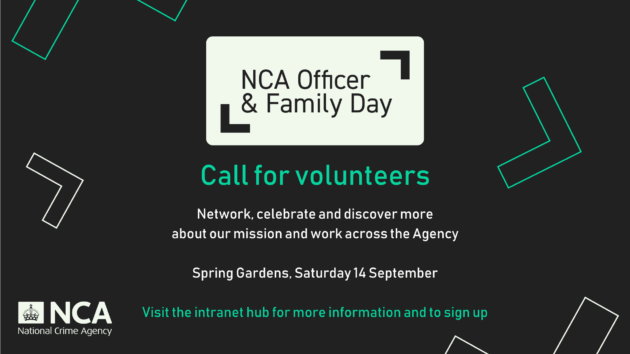
The promotional comms we used to call out for volunteers via our intranet.
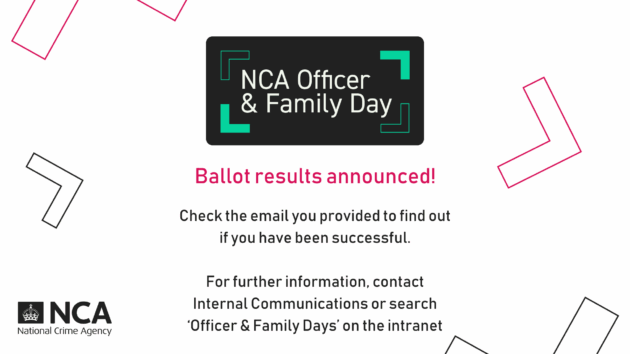
The announcement we used to reveal the ballot results.
How we managed demand: ballot and volunteer recruitment
As we could only invite a specific number of officers and their families to our sites, we introduced a ballot to ensure the process was as fair and transparent as possible. Leaders supported and amplified messaging to attract ballot applications from officers. Applications were selected randomly to be vetted, and approved, for an officer and up to three guests to attend the event. 346 officers applied to attend the pilot events, filling up both events to capacity.
We recruited 90 volunteers across both events through corporate and direct communications, and utilising staff employee networks. Lunch and learn sessions and in-person stalls (with the lure of free cakes!) encouraged engagement, with a friendly, personal touch.
What visitors experienced
Our Director Generals delivered presentations that showcased operational success stories, and this was also an opportunity to say thank you to both our officers and their families. Teams from across the NCA collaborated to develop engaging activities for all, which included:
- Demonstrations of cutting-edge technology, including a 3D printer and virtual reality headsets for training.
- Outdoor demonstrations from our therapy dogs and specialist dog handling units.
- Digital safeguarding activities for children and parents.
- Operational units showcased their work and how they protect the public, with uniform dress-up stations.
Delivering success: award-winning impact
Both events were successfully delivered, within budget, and received universally positive feedback from senior leaders, volunteers, guests and exhibitors. The events also went on to win a Director General commendation; an Association of Police Communicators Award and a silver Internal Communications and Engagement Award: Best Event category. The events were also featured in the September 2025 Institute of Internal Communications (IOIC) Voice magazine (link only available to IOIC members).
Around 300 people attended each event, and feedback was collected through post-event surveys and channel engagement. We used the Government Communications Evaluation Cycle to prepare a comprehensive report including recommendations for future events.
Of those who responded to our surveys, 100% said they enjoyed the events, while 92% of volunteers confirmed that the events gave them an opportunity to network with colleagues. 93% of attending officers, and 78% of volunteers, said that the events made them proud to work at the NCA, meeting our objective to boost officer pride and morale.
Comments from event guest books included:
“Thank you for inviting us – everyone is very welcoming with great information and big smiles! There are a lot of opportunities and it’s so much fun!”
“I want to work here! It was really good and inspiring.”
“It was lovely to share the agency’s work with my family.”
The success of these pilot events led to a third Officer and Family Day in Warrington in November 2025, this time with increased capacity and an even wider range of exhibits.
The learning from 2024 directly shaped our approach, for example, we used lanyards to identify guest time slots rather than wristbands to increase visibility. We also adopted collaborative Microsoft Teams tools for the project team and introduced an investigation trail for families to participate in.
This was proof that robust evaluation doesn’t just measure success, it enables it!