
Evaluating AI search accuracy
In this case study, the Office for National Statistics (ONS) demonstrates how the ‘Evaluate’ step of our PRIME framework can be used when assessing citation rates and verifying the accuracy of official statistics inside AI search summaries.
Read our guidance on strengthening public trust in the age of AI-powered search to learn more.
The challenge
As AI-powered search became more prominent, the ONS had limited visibility of how its official statistics were being presented in AI-generated responses. Given its role as the UK’s largest independent producer of official statistics, it was important to understand whether AI answers were representing figures accurately. This was important because data could be summarised, paraphrased or combined with third-party content in ways that affected a reader’s interpretation.
What they did
ONS conducted a longitudinal study of Google’s AI Overviews, chosen as the largest potential source of AI-generated answers for users seeking ONS statistics. They selected 12 population statistics queries and monitored AI-generated responses weekly over 14 weeks. An ONS subject matter expert assessed each query against official publications for accuracy and context.
They also measured ONS citation and mention rates, and reviewed which third-party sites were cited and which types of ONS content most often appeared in AI answers. They shared findings with content designers and digital teams across government, informing wider work on content lifecycle management and discoverability.
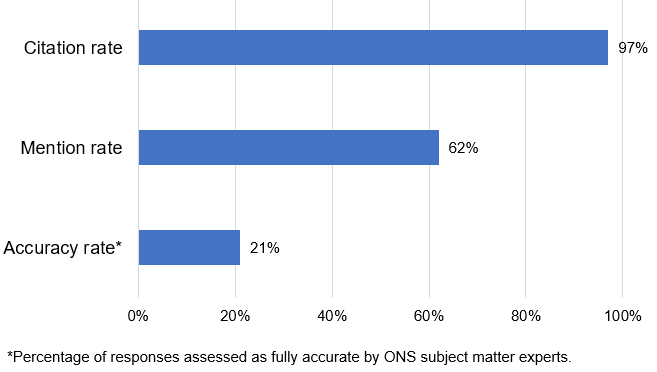
This chart shows the results of the ONS 14-week study of Google AI Overviews. There was a 97% citation rate for ONS URLs, a 62% mention rate for the terms “ONS” or “Office for National Statistics”, and 47 unique cited domains across 168 recorded results.
AI Overviews were generally reliable for headline figures, but less reliable for recency, source clarity and narrative framing.
The outcome
The research gave ONS a repeatable framework for assessing how its statistics are represented in AI outputs. While headline figures were often reproduced accurately, important caveats and context were frequently omitted, increasing the risk of misinterpretation. They also found examples of ONS and third-party information combined within a single answer, making attribution unclear.
Publications with a clear, prominent key message were more likely to be represented accurately, strengthening the case for ongoing content governance, including better internal linking and reducing outdated content.
Next steps
ONS is expanding its research across more topics and AI platforms. They are exploring ways to measure answer inclusion and citation at scale. They are also continuing to use subject matter expert reviews to assess accuracy, context and interpretation.