
Introduction
In a crowded, volatile, and often confusing information environment, the rise of misinformation and disinformation poses a direct threat to public services, societal cohesion and democratic trust. False narratives are frequently spread deliberately to sow mistrust, divide communities and damage societies.
Government communications represents the front line of this landscape. While it is not the role of democratic governments to restrict free expression or dictate acceptable thought, policymakers and communicators have a core responsibility to provide reliable information, promote the truth and safeguard public decision-making from hostile interference. Fulfilling this duty protects citizens from dangerous advice and the harmful behaviours driven by misleading narratives.
The disinformation puzzle
Effectively countering this threat requires democratic governments, media organisations and civil society groups to work together across several pieces of a complex puzzle:
- Neutralising hostile actors: Understanding the behaviours and motives of those who spread falsehoods to prevent malicious stories from entering the information ecosystem in the first place.
- Reforming technical architectures: Considering how technology and digital platforms contribute to the viral spread of misinformation, and implementing systemic adjustments to reduce their reach.
- Dismantling adopted beliefs: Responding effectively once falsehoods have already entered public discourse and been adopted as genuine beliefs by members of the public.
This final piece of the puzzle – using communications to disrupt and dismantle entrenched false narratives that lead to polarisation, conflict, and harm – is the primary focus of this toolkit.
Moving beyond the ‘Information-Deficit’ model
Historically, many common counter-disinformation strategies – such as mythbusting, direct rebuttals, and fact-checking – have relied on an intuitive ‘Information-Deficit’ model. This model assumes that a lack of true facts is the primary cause of misconceptions, and that simply supplying correct data should be enough to reverse them.
Operational experience and psychological research demonstrate that, in some circumstances, directly confronting myths using this mindset often fails to make a significant impact, and can backfire. Publicly challenging false information on official channels can unwittingly amplify it, making the falsehood more memorable and familiar to a wider audience.
Direct confrontation can also imply that there are two legitimate sides to a debate, creating a perception of genuine controversy where none exists. Furthermore, when an audience feels their deeply held convictions are attacked, they may experience psychological reactance – rendering them emotionally determined to hold onto their views while seeing the communicator as an adversary.
Introducing the Wall of Beliefs
To better combat disinformation, government professionals need to move past simplistic models and build a strong understanding of how beliefs are adopted, sustained, and given up. Overturning false beliefs is rarely as straightforward as simply supplying true information or debunking falsehoods.
This guide introduces the Wall of Beliefs – a simple model designed to help you analyse how audience identities, relationships, and worldviews dictate how beliefs are sustained or dismantled. The model uses the metaphor of a brick wall to emphasize the interdependency of beliefs, showing that each individual belief rests on and is supported by others.
By applying the Wall of Beliefs framework, you will learn how to:
- Analyse worldviews: Understand your target audience, their wider environment, and the structural factors that make false beliefs resistant to change.
- Deploy four strategic approaches: Master a comprehensive strategy matrix that balances communication and policy tools based on how deeply a brick is embedded in an audience’s wall and the immediate risk of harm it poses.
- Follow a structured five-step process: Apply the formal Wall of Beliefs execution process to map circulating narratives, discover belief strength, identify risks, and develop robust response plans.
Members can learn how to apply behavioural insights to counter false narratives by watching our Wall of Beliefs webinar (opens in new tab) in the Learning Hub. This session walks you through the psychology of false beliefs and how to map out a strategic response.
The role of governments in countering false beliefs
In a democracy, governments have a fundamental duty to facilitate the public’s access to full and accurate information so citizens can make free, informed choices. When public spaces are crowded with misinformation, discerning truth from falsehood becomes increasingly difficult. Fostering a healthy information landscape is essential to protect people from the real-world harm and dangerous actions driven by misleading narratives.
Core protections and freedoms
While public bodies must never restrict free expression or dictate acceptable individual thought, government interventions actively safeguard three core public freedoms:
- Freedom from false information that distorts public decision-making
- Freedom from systemic interference by hostile or malicious actors
- Freedom from dangerous advice capable of causing direct physical, financial or societal harm
Operational ethics and governance
To maintain public trust, all communication strategies must be grounded in high-quality audience insight and strictly adhere to the standards of the law and the Civil Service Code:
- Integrity: Putting the obligations of public service above personal interests.
- Honesty: Being truthful and open in all communications and public interactions.
- Objectivity: Basing advice and robust strategies strictly on rigorous evidence and validated analysis.
- Impartiality: Acting solely according to the merits of the case and serving governments equally.
In accordance with the Constitutional Reform and Governance Act 2010, any civil servant who becomes aware of operational activities or communications that conflict with the Civil Service Code must follow the formal departmental reporting procedures.
Applying the Wall of Beliefs
Our intuition can lead us astray when mythbusting and rebuttals fail
Mythbusting, debunking and rebuttal approaches are based on the assumption that lack of true information is the primary cause of false beliefs. From this intuitive assumption stems an intuitive solution: supplying correct information should be enough to overturn misconceptions. In academic literature, this is known as an Information-Deficit model of belief.
The Wall of Beliefs shows us that beliefs aren’t that straightforward, and that lack of information is not a sufficient explanation for why false beliefs take hold.
Apart from having varied effectiveness, fact-supplying approaches can sometimes backfire.
Publicly challenging false information can unwittingly amplify it, bringing it to a wider audience. This can make the information more memorable and familiar, increasing its presumed credibility, especially if addressed directly on official channels. Directly confronting myths can also imply that there are two legitimate sides to a debate, increasing the perception that there is a genuine controversy.
And when people feel that their deeply-held beliefs are being directly challenged, they may experience psychological reactance – an emotional state that makes them feel more determined to hold to their beliefs, viewing the challenger as an adversary.
Understanding the brick wall metaphor
The Wall of Beliefs aims to give communicators an introduction to the psychology of disinformation. Using the metaphor of a brick wall, the model strives to be simple, memorable, and intuitive rather than granular and academic.
The tool is not intended to impart a sophisticated understanding of the cognitive mechanisms behind belief formation. Rather, the model provides an accessible introduction to belief systems, moving communicators beyond an intuitive (but simplistic) Information-Deficit model of belief.
To communicate effectively, we need to understand how beliefs actually work. Think of an individual’s worldview as a sturdy brick wall where every belief relies on the surrounding bricks for support.
| Metaphor | Literal meaning |
| Beliefs are like the bricks that make up a wall. All together, these bricks make a sturdy wall. | Our beliefs are linked and interdependent. Each individual brick rests on others. A person’s worldview and beliefs therefore often remain stable over time. |
| Some bricks will be given by friends, family, or other trusted sources. These bricks might be very important to people. | Beliefs that are strongly linked to personal relationships and identity may be particularly embedded and resistant to change. |
| Trying to remove a single brick may be impossible, or it may cause the wall to collapse. | Trying to correct a single false belief might be difficult if it’s integral to an individual’s mental model or gives rise to many other beliefs. Tackling these deeply embedded beliefs can have unpredictable consequences for someone’s worldview. |
| You might have to remove and replace several bricks to fit a new brick in. | Correcting beliefs that are part of a mental model, or which give rise to multiple other beliefs, might require quite significant changes in understanding and new mental models to be built, with new information. |
| Some bricks might be very stuck in place, while others are looser and easy to remove. | New or uncertain beliefs might be easy to change, while others might be harder to change. |
| Rebuilding a wall is tiring, and takes effort that people don’t always have. | Changing your beliefs takes effort and consideration, and people may not wish to disturb a stable belief system. |
| When trying to adjust a brick, consider the surrounding and supporting bricks. What bricks does it depend on? What other bricks depend on it? | When trying to change a person’s beliefs, you need to consider linked beliefs, and how beliefs fit into existing mental models. |
| If you are trying to replace or remove a brick, help people rebuild the right part of their wall easily. | When disrupting existing mental models, help people rebuild their understanding with clear, accessible, and satisfying explanations. |
| You can also challenge harmful behaviours without moving any bricks. | In some cases, challenging harmful behaviours without immediately tackling beliefs and attitudes might be the best course of action. |
Why is supplying true information not enough to change beliefs?
There are many reasons why people may adopt and sustain beliefs despite challenges, or why they may continue to believe or share false information despite corrections and counter-disinformation communications.
Beliefs are intensely personal, and can fulfil many needs for people beyond simply aiming to discover the truth:
- Community and belonging: People may hold the same beliefs as others in their community or social group, to secure a sense of belonging and a shared understanding.
- Relationships with others: People may hold beliefs that come from trusted friends or family members, to nurture those relationships, or avoid conflict.
- Explanations for complexity: People may hold beliefs that purport to provide a simple explanation for complicated events, in an attempt to avoid feelings of helplessness or anxiety.
- Self-esteem: People may hold beliefs that preserve their own self-esteem or that of a group they are in (for example, believing in conspiracies that pin the blame for negative events on a certain individual, group, or institution).
- Justify behaviours: People may hold beliefs that excuse or justify behaviours that they wish to engage in or avoid (for example, adopting climate-sceptic beliefs out of reactance to being instructed to adopt green behaviour changes they do not want or cannot afford to adopt).
- Save face: People may maintain beliefs that they have publicly proclaimed a strong and sincere commitment to at some point in the past, to avoid the embarrassment or perceived social indignity associated with changing their mind (“saving face”).
- Preserve sacred values: People may hold onto beliefs because they form a foundational part of their identity and worldview, the maintenance of which is essential for their self-esteem and ability to interpret and understand the world (for example, many communities will hold shared ideals, known as “sacred values”, such as justice, the sanctity of human life or belief in a higher power which will be non-negotiable).
- Fear of reprisal: People may hold onto beliefs because they fear reprisals for adopting alternative ones (for example, citizens living in oppressed nations can be sent to prison or even killed for expressing views that are in opposition to state-sanctioned narratives).
In some cases, people may actively avoid information that challenges their beliefs, or may steadfastly ignore their own doubts or concerns in order to sustain beliefs that serve them in some way. In these circumstances, simply providing true information is unlikely to successfully overturn false beliefs.
Four approaches to countering disinformation and false beliefs
When deciding how to fight false information, you cannot use a one-size-fits-all approach. You must choose a strategy based on two things: how deeply embedded the belief is in your audience’s wall, and how much immediate harm the belief causes.
There are four core strategic approaches you can deploy as shown in this diagram.
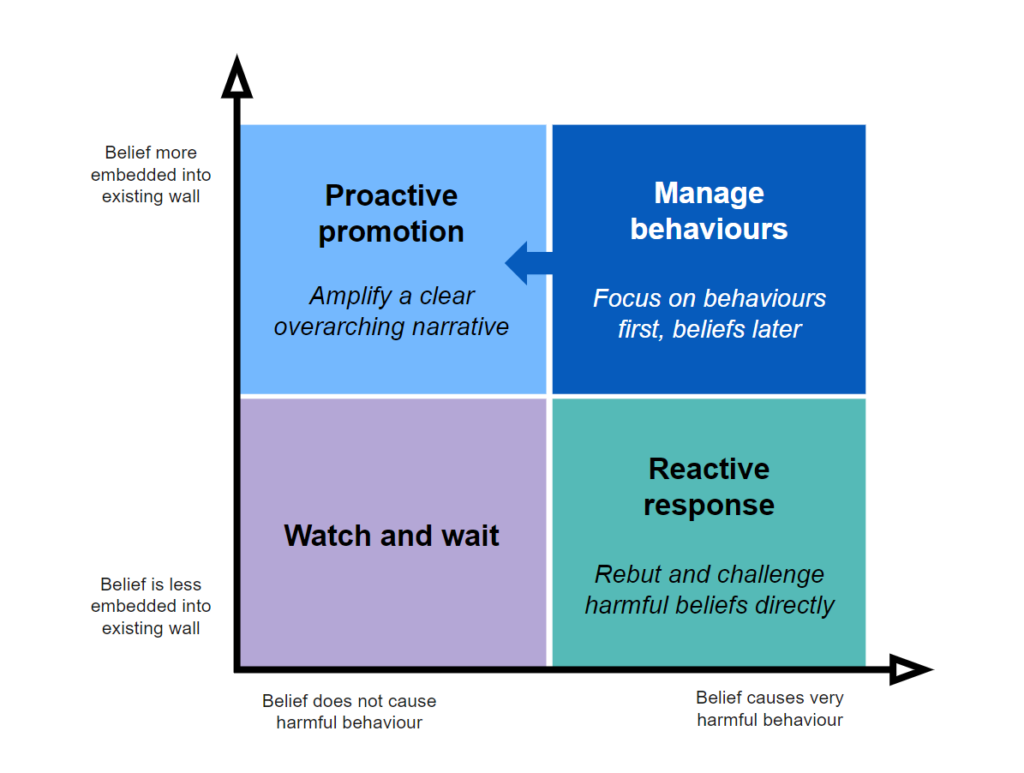
This diagram shows the four strategic approaches to countering disinformation and false beliefs. Click on the image to view a bigger version.
Manage behaviours: Prioritise stopping the dangerous action directly. Use this when a false belief is deeply rooted but causes immediate real-world harm. You focus on changing the behaviour first, and worry about changing the underlying belief later.
Proactive promotion: Consistently communicate a positive, true, and easy-to-understand narrative. Use this when false beliefs are deeply held but are not causing immediate harm. You build public understanding of the truth without directly arguing with the myth.
Reactive response: Challenge the lie directly using fact-checking, mythbusting, and rapid rebuttals. Use this only when a belief is not deeply held, but it poses an immediate risk of dangerous behaviour.
Watch and wait: Take no immediate communication action. Use this when a false narrative is new or loose, and is not causing any harmful public behaviours. Instead, you simply monitor the rumor to see if it spreads or becomes dangerous.
Scaling belief strength: How to choose your strategy
To pick the right quadrant from the four approaches above, you must first diagnose where the public’s misconception sits on the scale of belief strength.
Some false beliefs are easy to change – particularly those that might be new or uncertain – while other false beliefs may be more embedded as they form part of someone’s identity or worldview.
As illustrated in the diagram below, the most deeply embedded beliefs are likely to be foundational beliefs that stem from sacred values. The least embedded beliefs might be those derived from recent news or rumours.
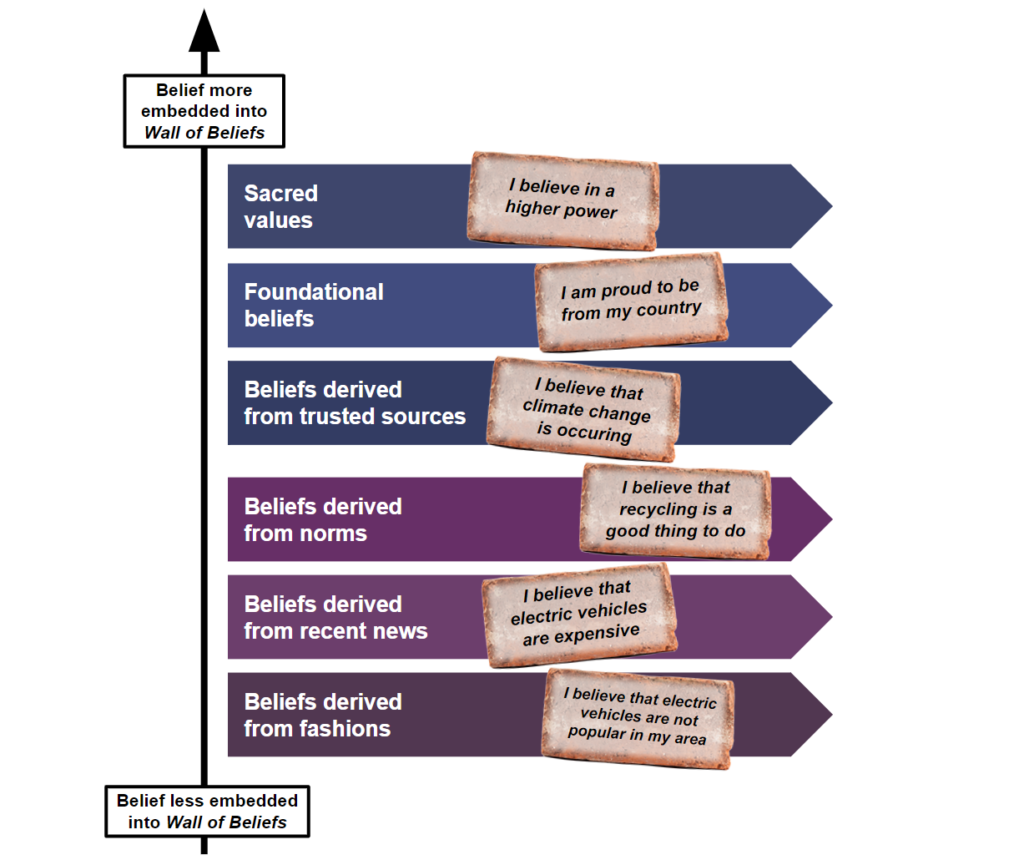
This diagram shows the scale of public beliefs embedded within the Wall of Beliefs. Click on the image to view a bigger version.
False beliefs can drive harmful behaviours – or stop people from taking positive actions – by making safe choices look dangerous or dangerous choices look safe. For example, the false belief that the Measles, Mumps and Rubella (MMR) vaccine causes autism can scare people away from life-saving medical care, while believing that unproven home remedies protect against viruses can lead people to take dangerous risks. However, not every misconception triggers an immediate problem; some false beliefs cause no visible behaviour changes at all, at least in the short term.
Because of this variation, a single false belief rarely affects everyone in the exact same way. Different groups of people will often sit in completely different quadrants of the strategy matrix. A rumor might be deeply trusted by one community but viewed as a casual, passing news story by another. When this happens, you will need to deploy multiple strategies at the same time, carefully targeting each approach to match how that specific audience group thinks and behaves.
Manage behaviours
Manage Behaviours is the first of the four strategic approaches within the counter-disinformation matrix. This approach is specifically deployed when an audience holds a deeply embedded false belief that is actively driving a high risk of immediate, real-world public harm.
When beliefs are highly embedded and also cause harmful behaviours in the short term, the best strategy may be to disrupt these harmful behaviours directly without initially challenging the false beliefs that led to them. Attempting to dismantle the underlying belief block is likely to take too long to mitigate the immediate danger.
Once harmful behaviours are managed, communicators can shift to a proactive promotion strategy to tackle deeply-embedded beliefs, as covered in the next section.
What is managing behaviours?
Beliefs influence behaviours, but they are not the only influence. Sometimes people do things that are inconsistent with their beliefs. Communications (and other interventions) can be used effectively to encourage behaviour change without tackling the underlying beliefs that lead to the harmful behaviour.
Methods of challenging behaviours without challenging beliefs include:
- Making a desired behaviour as easy as possible
- Making a harmful behaviour more difficult
- Using a different messenger to deliver instructions and advice
- Communicating the desired behaviour using arguments that are unrelated to contentious beliefs or specific worldviews.
Why is managing behaviours recommended in this situation?
When highly embedded beliefs are causing harmful behaviours, there may not be enough time to use communications to influence a change in these beliefs. Therefore, it may be most appropriate in the short-term to prioritise behaviour change and mitigation of the most harmful behaviours.
Over time, behaviour change can eventually lead to changes in belief. Self-perception theory suggests that our actions influence our self-image, which can in turn influence our behaviour. By promoting behaviour change we can thus eventually create changes in beliefs and norms.
While challenging behaviours should be a priority where there is risk of immediate harm, this strategy can be implemented alongside a long-term proactive promotion strategy to address deeply-held beliefs over a longer time period.
How to design an effective strategy to manage behaviours
Incentives and barriers
Work with policymakers to put incentives and barriers in place to make harmful behaviours more difficult, and desired behaviours easier.
Introduce barriers to people carrying out harmful behaviours
Some particularly harmful behaviours can be reduced by making them harder to undertake, such as by introducing bans, fines, regulations or practical hurdles. While communications alone can’t introduce these barriers, communications can publicise the existence of barriers.
For example, in 2012, the UK Government banned the sale of incandescent light bulbs so that only energy-efficient bulbs were sold in UK shops, meaning that when people need to replace their incandescent bulbs they can only buy new energy-efficient versions, irrespective of their beliefs about climate change.
Remove practical hurdles to people carrying out the desired behaviour
If people’s beliefs are preventing them from doing a desirable behaviour (for example, getting vaccinated), identify whether there are any practical factors that are also hindering people’s ability to carry out the behaviour, and work with policymakers to remove them. If a behaviour is complex, time-consuming or costly, policymakers should find ways to make it quicker, simpler and cheaper, and communications can be used to inform people about changes that make the desired behaviour easier.
For example, a key feature of the UK’s COVID-19 vaccine rollout was making vaccinations highly accessible through walk-in centres, local pharmacies, and GP surgeries. By removing the need for appointments, the programme eliminated time and cost barriers for hesitant individuals. Offering vaccinations on an ongoing basis also gave people the time they needed to see emerging evidence of safety and efficacy before choosing to get the jab.

A campaign example from the NHS, focusing entirely on a direct behavioural call-to-action. Click on the image to view a larger version.
Make desired behaviours attractive or rewarding
If people’s beliefs are preventing them from doing a desirable behaviour, making the desired behaviour attractive or rewarding may increase the likelihood that people will do it anyway.
For example, although air travel is the preferred mode of transport between countries, between 1994 and 2020, an estimated 20 million people chose to travel between the UK and France on the Eurostar. The Eurostar does not brand itself as green and people often react strongly against calls to reduce air travel for the sake of the environment; rather, the associated carbon savings of these journeys are a positive unintended consequence of the Eurostar’s reputation as a comfortable and convenient way to travel.
What to communicate
Showcase other people undertaking the desired behaviour
In some cases, people will take their cues about how to behave from what they see other people around them doing, especially people with whom they share a social identity. Showcase examples of people undertaking the desired behavioural action, but without linking their behaviour to a change in underlying belief. For example, a poster showing pregnant women getting vaccinated could serve as a social cue to other pregnant women to get vaccinated.
How to communicate
Be specific about what you want people to do
When promoting a behaviour, people are much more likely to do it if you clearly spell out what you want them to do (the call to action) and how. The action should also feel achievable. For example, a standard message issued by the UK Government at the height of the COVID-19 pandemic – “Wash your hands more frequently and for at least 20 seconds” – used a graphic of someone with soapy hands, this was extremely clear, very specific and felt achievable.

A public health campaign example from HM Government, showing a direct focus on clear, action-based instructions to encourage safe public behaviours. Click on the image to view a larger version.
Make calls to action easy to understand
Another important factor is making sure that calls to action are easy for your target audience to understand, taking into account the varying comprehension needs and challenges. In addition to making the call to action specific, messages aimed at a broad audience may also need to be translated into multiple languages and should be written free of jargon or technical terms.
Frame desirable actions as if they are the default behaviour
A good way to motivate people to adopt the behaviour promoted in communications is to signal that the desirable behaviour is the standard course of action. For example, when inviting people to book a vaccine appointment, messages like “It’s time to book your appointment” carried a stronger suggestion of a default action than messages like “It’s time to decide if you want to get vaccinated.”
Avoid linking desired behaviour to beliefs, values or worldviews
When promoting a behaviour, avoid linking it to specific beliefs, values or worldviews, to reduce the likelihood that people will experience psychological reactance or cognitive dissonance.
For example, do not promote vaccination by saying “Responsible citizens get vaccinated” as people with vaccine-hesitant beliefs may perceive this as an attack on their values and identity.
Avoid accusing people who change their beliefs of inconsistency or hypocrisy
Do not accuse people of being inconsistent or hypocritical if they undertake desirable behaviours that appear to be inconsistent with their values or worldviews, as this might be perceived as an attack, increasing psychological reactance or cognitive dissonance.
Broader considerations
Ensure policies and processes allow people to easily change their behaviour without requiring them to publicly acknowledge inconsistency with their underlying beliefs or to confront a recent change in their beliefs. By helping people to save face, behaviour change will be more likely.
Examples of managing behaviours
COVID-19
During the COVID-19 pandemic, some groups strongly rejected wearing face masks, often accompanied by negative attitudes towards other rules and guidance to reduce the spread of the virus. These anti-mask views often coincided with belief that the risk of COVID-19 was being exaggerated by authorities and the health service, and doubt in the trustworthiness of government advice. These attitudes were deeply embedded among a small but significant audience segment and led to people refusing to follow guidance putting themselves and others at risk.
Challenging people’s deeply-held beliefs about the government and health service is a significant undertaking, and would not have been effective quickly enough to prevent immediate harmful behaviours.
So rather than targeting this group with adversarial debunking messages, a simpler technique was to make the target behaviours. Providing free masks at the entrance to hospitals, and making social distancing a “default” in public spaces (with signage and floor markings) reduced the need for sceptical individuals to make a conscious decision to follow the guidance against their own beliefs.
Voting behaviour
In many countries, voting is more common in some groups than others. Decisions about whether to vote have a range of influences, which include whether people feel like their vote will have a meaningful impact on the outcome and whether they feel a civic duty to vote. Deep distrust in politics and a belief that “nothing will change” are difficult attitudes to challenge in the short term.
A more effective strategy, then, might be to make voting as easy and straightforward as possible. If voting requires very little time and energy, people may be tempted to do it anyway, even if they do not have strong motivation to do so.
If unenthusiastic voters start to vote regularly, due to the ease of voting, then this may also eventually lead to a change in self-perception, with people perceiving themselves as more politically engaged than before. This may lead to other attitude and behaviour changes in the longer term.
Sharing false beliefs online
Some false beliefs (such as anti-vaccination sentiment) give people a sense of belonging within a particular community or social status for holding and expressing those views. People who hold these beliefs may be inclined to share these views regularly with other people in their community, especially on online platforms, where these views can reach large numbers quickly.
Rather than change the underlying beliefs, social media platforms have implemented several measures to make people less likely to share misinformation. Articles flagged as “disputed” are shown less prominently on Facebook, meaning that fewer people have the opportunity to see them and share them. These articles are also flagged with a “disputed” or “misleading” marker, making them less socially acceptable to spread. WhatsApp similarly flags virally shared content to help people discern between viral content and messages written by their immediate network.
Proactive promotion
Proactive promotion is the second of the four strategic approaches available to communicators and policy makers. This approach is recommended when a false belief is deeply rooted in an audience’s wall, but does not present an immediate threat of harmful behaviour. Instead of engaging in counterproductive public arguments that risk reinforcing the myth, this strategy focuses on consistently building a strong, clear, and visible alternative narrative based entirely on the truth to slowly shift public understanding over time.
What is proactive promotion?
Proactive promotion is a strategy that centres around communicating the truth – but without directly engaging with false stories or myths.
A proactive promotion strategy requires communicating true information in a compelling way, using a range of channels, with particular focus on presenting information in a way that is easy to understand and recall.
The goal of proactive promotion is not to directly counter myths, but to consistently communicate an accurate and coherent “other side of the story” that deepens public understanding of the truth and builds resilience to false information.
It requires storytelling and the development of a narrative. In other words, it is not enough to communicate facts and figures alone – they need to be contextualised in communication that explains why, how and so what?
To execute a proactive promotion strategy, communicators must:
- Establish true information, and build it into a compelling and coherent story that gets across the key facts
- Use this narrative to design memorable and accessible communication and campaign materials (for example, articles, blogs, speeches, and social media posts) that repeat and reinforce this true information
- Share these materials consistently over time, using a range of channels, to build public understanding and knowledge about the issue at hand
Why is proactive promotion recommended in this situation?
When beliefs are embedded and resistant to change, this is typically because they form part of a person’s “worldview” – a set of beliefs that link together and influence how the person interprets the world around them.
When people feel that their worldview is being challenged directly, they may feel defiant and even more determined to hold on to their beliefs, viewing the challenger as an adversary. Proactive promotion approaches aim to help people construct a new and more informed worldview over the longer term, rather than tackling individual false beliefs head-on.
Research shows that people are more inclined to believe information that is straightforward and easily comes to mind. But in many situations, myths and false stories are appealingly simple, while the truth is more complicated and nuanced. Proactive promotion approaches aim to make the truth as straightforward, memorable, and coherent as possible so that people don’t fall victim to false information while seeking clear answers about complicated topics.
Proactive promotion is typically a medium to long-term strategy and is, therefore, most appropriate when the false belief is not causing immediate harmful behaviours.
How to design an effective proactive promotion strategy
Determine whether beliefs are fulfilling a need for the audience
People may adopt false beliefs for many reasons, such as needing to feel a sense of belonging in a group, or needing a simple explanation for complex and disconnected events. Consider whether there are other ways to fulfil the audience’s needs, and use communication and campaign materials to advance these efforts where possible.
What to communicate
Develop a story that gets across the key facts, based on truthful information
Establish the facts of the situation, and develop them into a coherent and consistent narrative that “tells the story” of the truth. Use this information to develop interesting and engaging communications and campaigns that reinforce this truth.
Amplify new information and emerging evidence
People may find it easier to change their beliefs when presented with new information, as updating beliefs in response to new evidence is typically more desirable and less emotionally and socially costly than changing beliefs simply due to reconsidering existing evidence.
Highlight unknowns and uncertainties
Where there is uncertainty or a lack of evidence, acknowledge this directly, and explain why information is unknown or uncertain.
Demonstrate that changing your mind is possible
Use first-person accounts or case studies to show that others have adopted new beliefs or have changed their views in response to new information, to reduce perceived stigma or embarrassment associated with changing beliefs.
Encourage doubts, rather than directly attacking sincere beliefs
People with conspiratorial beliefs may experience doubts about some elements of their beliefs, and messaging should encourage them to think more deeply about these doubts, drawing attention to the lack of evidence or corroboration for more extreme or doubtful claims. For example, if someone believes that vaccines are part of a global conspiracy to harm people, drawing their attention to historical diseases that have been eradicated by vaccines may be more effective than ridiculing their conspiratorial beliefs.
Help people explore their doubts
Sometimes people experience doubts about their beliefs but are unwilling to consider changing them as it can feel uncomfortable or overwhelming. Help people explore their doubts without rushing them by signposting them to further information or specialist advice if they are struggling with their beliefs.
Align messaging with the audience’s sacred values
Identify any important sacred values held by the audience, and appeal to these in communication and campaign materials. For example, if the relevant audience is highly patriotic, campaign materials could set out facts in a way that encourages national pride.
Avoid positioning messaging in opposition to the audience’s sacred values
People are unlikely to be receptive to messages that challenge their sacred values. For example, if talking to a religious audience about vaccination, a message like “Your faith won’t protect you from disease” is likely to be rejected and perceived as an attack.
How to communicate
Utilise teachable moments
A teachable moment is a time when audiences are more receptive to new information, due to external events that make relevant topics salient or widely known. “Teachable moments” can provide a useful trigger point to amplify truthful information to counter disinformation narratives. For example, in early 2020 a record 47% of the UK’s power came from renewable energy, which provided a useful teachable moment to inform the public about significant government efforts to increase the use of green energy sources.
Use a range of channels, including in-group messengers
Determine which messengers and channels are trusted by the relevant audience, and seek to share the narrative through these messengers and channels. Ideally, ensure that information is shared through multiple channels that are not perceived as closely aligned by audiences.
Broader considerations
Ensure that information and communication materials are preserved and can be repeatedly accessed if audiences wish to return to them and that narratives and key messages are consistent across channels. If information changes or new evidence emerges, be transparent about this, explaining what changed and why. In the longer term, interventions that improve media literacy and numeracy can help people distinguish between truths and false information in the wider information ecosystem.
Examples of proactive promotion
Climate change
The majority of people in the UK accept that climate change is occurring and is caused by human activity, but a minority continue to believe that the climate is either not changing or that such changes are not caused by humans.
Those who are sceptical are typically quite firm in these beliefs and listen to a relatively small number of scientists and commentators who promote these views. These beliefs may be closely linked to doubts about the trustworthiness of government messaging, and concerns about mainstream science and media.
While not believing in human-caused climate change might mean that these audiences don’t engage in green behaviours, most of the time these beliefs are not likely to be causing immediate harm. For beliefs like these, directly countering false stories and statements about the reality of climate change runs the risk of promoting false stories to a much wider audience, and is unlikely to change the views of climate-sceptic audiences who are committed to their stance.
Instead, a proactive promotion approach might be more effective. This will involve promoting a true, clear and easy-to-understand narrative that explains how we know that climate change is caused by human activity, citing evidence. It does not need to address specific false claims, but should instead focus on establishing a coherent and consistent explanation that stands alone and is repeated and reinforced over time.
Sanctity of the nation-state in non-democratic regimes
Many governments around the world aim to foster a sense of national pride amongst citizens. In healthy democratic states, this may include activities such as celebrating national holidays, recognising the successes of citizens (for example athletes or business leaders), the teaching of national history in schools, and championing the natural beauty of the country.
In non-democratic states, additional or alternative tools are sometimes used, including:
- The suppression of information or news that may undermine the established narrative
- Erasure of past historical events that are inconsistent with the official national story
- Sustained disinformation campaigns to build or retain a certain worldview amongst its citizens and
- Penalties for any individuals or groups who speak out against the official narrative
Depending on how long such regimes have been in power, citizens living in such countries may have had their entire lives to construct a worldview composed of information that is untrue and incomplete.
The foundational beliefs that make up someone’s worldview are often considered sacred (non-negotiable truths that people will react strongly against if challenged) and populations in oppressed states are likely to fear reprisal for consuming information that directly conflicts with official narratives. Consequently, a proactive promotion approach is much more likely to be effective in these cases. This will involve providing an accessible, compelling alternative narrative that does not directly conflict with sacred values.
Take, for example, the narrative promoted by Putin of a unified Russian identity, united by a shared language, religion and Soviet history, that encompasses Russians in Russia and the Russian-speaking diaspora living in former Soviet nations. The concept is known as “Russkii Mir” (Russian World). If a campaign were to try to change these beliefs by dismissing the concept of “Ruuskii Mir” and arguing that many citizens of former Soviet countries do not view themselves as Russian, this would put Russian values in direct opposition to Western values.
In a competition between sacred values and alternative “foreign” values, sacred values will likely win out. Instead, a more successful counter-campaign would focus on promoting other positive values such as democracy, freedom of information and tolerance, without attacking the existence of “Russkii Mir”. In this way, people are able to hold onto both sets of values at the same time (thereby preserving self-esteem and avoiding cognitive dissonance), until a point where they might be able to let go of views that are less grounded in evidence.
Reactive response
Reactive response represents the third strategic approach in the matrix and serves as your direct counter-offensive tool. This approach is only chosen when a circulating false belief is not deeply embedded in the audience’s wall, but poses an immediate and dangerous risk to public safety or behaviour.
Because the belief is still loose and un-cemented, you can safely use fast, high-visibility communication tactics – such as rapid rebuttals, fact-checking, and mythbusting – to challenge the lie directly before it takes root.
What is a reactive response?
Reactive response approaches involve challenging false stories and statements directly, including debunking, fact-checking, and direct rebuttal. In some cases, mythbusting may be suitable as part of a reactive response strategy.
To execute a reactive response strategy, communicators should:
- Quickly and directly address the relevant false stories or disinformation
- Explain in a straightforward way why the story is false (with care taken not to “overkill” it – too many reasons or too strenuous a denial can paradoxically appear less believable)
- Ensure that the truth is set out clearly, and is easy for audiences to understand and remember
- Ensure rebuttal messages are aligned with broader narratives
Why is reactive response recommended in this situation?
As detailed above, reactive response approaches, particularly mythbusting, carry risks. These risks include amplifying false information, spreading it to a wider audience, creating the perception of a two-sided debate, and triggering reactance in individuals who hold the false belief. This is why it is recommended only when beliefs are not highly embedded, and when there is an immediate risk of harmful behaviour.
When beliefs are non-embedded and likely to lead to harmful behaviours, we can and should intervene. These new or loosely-held beliefs are easier to dispel with direct rebuttal than more embedded ones.
How to design an effective reactive response strategy
Identify relevant false beliefs and affected audiences
Publicly debunking falsehoods that are not widely believed, or are only believed by a small minority, can unwittingly amplify them to a broader audience, so it is very important to have a clear understanding of the prevalence of the relevant false belief and the audiences involved.
What to communicate
Provide truthful information
Establish the facts of the situation, and develop them into coherent and consistent communications and campaign materials that explain why the relevant beliefs are false and set out the true facts.
Set out the truth in a way that is easy to understand and recall
When false assertions are simple and memorable and true assertions are complicated or confusing, the false assertions are more likely to stick in the minds of the audience (and memorability, “I’ve heard this somewhere before,” is a common heuristic for truth). When debunking false information, it is important to make sure that the truth is presented in a way that is straightforward, memorable and easy to understand.
How to communicate
Use non-judgmental language and tone
Avoid messaging that implies that people who believe the false information are foolish, naive or gullible. If people feel attacked for their beliefs they are likely to reject debunking messages and experience psychological reactance.
Target communications to the relevant audience
Target debunking information to the relevant audience where the false belief is most prevalent, using relevant channels and messengers. Consider the risks of communicating reactive response messages to a broader audience where the false belief may not be widely prevalent.
Avoid presenting falsehoods in a prominent manner
Consider that many people “skim read” mythbusting and debunking materials. If your campaign highlights a falsehood while making the correction hard to see – such as putting a small “Incorrect” label next to a large rumour – people may walk away believing the lie is true and officially endorsed.
Use a range of channels, including in-group messengers
Determine which messengers and channels are trusted by the relevant audience, and seek to share debunking messages through these messengers and channels. Ideally, ensure that information is shared through multiple channels that are not perceived as closely aligned by audiences.
Broader considerations
Minimise confusion and noise in the information landscape
Ensure that information and communication materials are preserved and can be repeatedly accessed if audiences wish to return to them and that key messages are consistent across channels. If information changes or new evidence emerges, be transparent about this, explaining what changed and why.
Examples of reactive response
COVID-19 ‘cures’
During the COVID-19 pandemic, rumours and false stories circulated on social media about potential “cures,” including garlic, lemon juice, salt water and medications intended for the treatment of other illnesses. As the disease was new to people, beliefs about cures were also new and not deeply embedded. This false information carried a high risk of triggering immediate harmful behaviours (both consuming “cures” that may be actively dangerous, and shunning medical advice about how to correctly prevent and treat COVID-19).
In this situation, a reactive response approach – directly debunking false claims – was an effective strategy. People didn’t have deeply-held beliefs about cures that they wanted to defend, and immediate and direct rebuttals from the health service helped prevent these beliefs from taking firm hold (among most audiences) and causing further harm.
Storm communication
Reactive response approaches are appropriate in fast-moving situations where beliefs are new and behaviours carry a high risk of harm. In extreme weather situations, such as a storm, people quickly judge and often re-evaluate whether it is safer to stay at home or to leave.
While people in general often have the deeply embedded belief that their home is the safest place to be in a crisis, their belief about the danger of any current storm is constantly changing. To determine whether it is safe to stay put, people may use their senses and turn to social media, neighbourhood communications and official sources.
As such, governments need to apply a reactive response approach when storms are dangerous enough to prompt evacuation. At this point, governments should actively respond to rumours online that downplay danger by providing information about ongoing damage and highlighting others who have evacuated.
Watch and wait
Watch and wait is the final approach of the four strategic options outlined in this framework. This strategy is adopted when a false narrative or rumor is weak, newly emerging, or loosely held, and is currently causing no harmful public behaviours or disruption. Rather than overreacting and accidentally drawing unnecessary public attention to a minor issue, your role under this approach is to closely monitor the narrative’s spread and track whether it begins to gain traction or threaten public safety.
What does watch and wait mean?
When beliefs are new and are not particularly embedded among the target audience, and are also not causing any harmful behaviours, watching and waiting can be the most effective strategy.
Watching and waiting involves taking no immediate communication action to dispel a false belief. Instead, communicators should continue to monitor the false belief for signs that it is becoming more embedded or is causing harmful behaviours, in which case a shift in strategy may be required.
Why is watch and wait recommended in this situation?
Disinformation and false stories can create new, non-embedded beliefs. As communicators, we are biased toward action, mythbusting and correcting as soon as we can. At times, however, this can lead to amplifying misinformation rather than correcting it. If the belief is unlikely to cause harmful behaviours we might therefore want to consider taking no action. We might instead adopt a monitoring approach, tracking whether the belief is spreading further or leading to harmful behaviours.
Examples of watch and wait
Astrology
Astrology is an example of a false belief that some audiences entertain for pleasure. Among a minority of audiences, it may be a highly embedded belief (coinciding with other beliefs in supernatural forces), but in the general population, astrology is either ignored or tentatively believed as a way to derive personal insight and entertainment. In the vast majority of cases, a loose belief in astrology is unlikely to lead to immediate harmful behaviours.
In this case, monitoring and waiting is likely to be the most effective strategy. No government in the world (to our knowledge) has implemented a counter-astrology campaign, despite it being a widely-held false belief. If astrology began to trigger harmful behaviours, then a shift in strategy should be considered.
Don’t swim after eating
Another common false misconception in the UK (and other countries) is that eating before swimming can cause cramps. To reduce drowning risk, parents therefore commonly tell their children that they should not swim immediately after eating. Existing evidence however suggests that no such danger exists: cramps are not more likely immediately after eating.
This belief is unlikely to be deeply embedded, as it does not typically form part of a wider worldview. Waiting for thirty minutes before swimming is not harmful, and thus the most effective strategy for this type of misconception is typically monitoring and waiting, taking no immediate action.
Using the Wall of Beliefs to develop communications plans
When false beliefs or disinformation narratives are detected
If a false belief or disinformation narrative is causing concern, we advise the following approach, drawing on the Wall of Beliefs model and strategy matrix.
Step 1: Explore the wall
The first step is to determine where the belief fits within the Wall of Beliefs of your target audience.
- Use user research, focus groups, academic literature, media stories and other public information sources to find out whether the belief is part of a broader worldview, and how it links to other beliefs.
- Explore which beliefs it commonly coincides with and whether it fits within a wider narrative that is understood and believed by the target audience.
Step 2: Discover belief strength
The next step is to determine how embedded a belief is within the Wall of Beliefs of your target audience.
Use similar sources to determine whether beliefs are newly adopted or long-embedded, whether audiences feel particularly strongly about them, whether they fit into broader false narratives, and whether people feel a personal connection to the belief.
Step 3: Determine the risk of harm
The third step is to determine the harm caused, or risk of harm posed, by the belief or set of beliefs in question.
Consider whether a belief is causing people to engage in risky behaviours, or to shun protective behaviours, and whether these harmful behaviours are widespread or rare among the target audience.
Step 4: Use the strategy matrix
The fourth step is to use the strategy matrix to explore the most suitable communications approach, depending on the quadrant in which the belief falls.
If the belief falls in different quadrants for different audiences, it may be necessary to consider a combined approach, targeting different communications at different audiences.
Step 5: Develop a response plan
Use the principles from the corresponding section(s) of the strategy matrix to develop a communications response plan, and policy response if required to manage behaviours.
When harmful, belief-driven behaviours are detected
In some circumstances, harmful behaviours (or harmful absence of behaviours) might be identified first, with policymakers suspecting that these are influenced by false beliefs. In this case, it is necessary to first determine which beliefs are influencing the harmful behaviour, before assessing the appropriate strategy to counter them.
Step 1: Determine beliefs influencing behaviour
The first step is to identify which beliefs are influencing the harmful behaviour of interest.
Use primary research, existing research, media stories, and other public information sources to identify key beliefs that are influencing the behaviour of interest.
Step 2: Explore the wall
The second step is to determine where such a belief might sit within the Wall of Beliefs of your target audience.
- Use user research, focus groups, academic literature, media stories, and other public information sources to find out whether the belief is part of a broader worldview, and how it links to other beliefs.
- Explore which beliefs it commonly coincides with and whether it fits within a wider narrative that is understood and believed by the target audience.
Step 3: Discover belief strength
Determine how embedded a belief is within the Wall of Beliefs of your target audience.
Use similar sources to determine whether beliefs are newly adopted or long-embedded, whether audiences feel particularly strongly about them, whether they fit into broader false narratives, and whether people feel a personal connection to the belief.
Step 4: Use the strategy matrix
The fourth step is to use the strategy matrix to explore the most suitable communications approach, depending on the quadrant in which the belief falls.
If the belief falls in different quadrants for different audiences, it may be necessary to consider a combined approach, targeting different communications at different audiences.
Step 5: Develop a response plan
Use the principles from the corresponding section(s) of the strategy matrix to develop a communications response plan, and policy response if required to manage behaviours.
Example: Increasing electoral participation among minority groups
In your country, certain minority groups have a long-standing history of low electoral participation. In recent years, electoral participation has fallen further. You are tasked with increasing electoral participation among these minority groups in an upcoming election.
- Establishing the Wall of Beliefs: Using information sources, you identify key beliefs that may keep members of the minority group from voting.
- Determining how embedded a belief is: You estimate the strength and prevalence of the different beliefs. Given that voting participation is a long-standing issue, some beliefs are likely deeply embedded. Since the voting share has recently declined further, it is also possible that some new beliefs are also influencing limiting electoral participation.
- Determining where these beliefs fit in the strategy matrix: Among the more deeply embedded beliefs, you can identify which ones play a key role and seem like they would respond to a proactive promotion approach. Perhaps there is a belief that “the government doesn’t represent people like me”, which might be easily influenced by a campaign highlighting parliament members belonging to the minority group in question. Among the less embedded beliefs, determine which are likely to be most damaging to electoral participation, so you can explore countering these directly.
- Developing your communications and policy response: Because the challenge is long-standing and complex, you will likely need to combine approaches from the different quadrants. You can promote behaviour change without targeting beliefs by simplifying the voting process, tackle harmful but less embedded beliefs with a “reactive response” approach, and deliver a proactive promotion campaign to target the most embedded beliefs over the medium to long term.
The boundaries of the Wall of Beliefs
Information ecosystems
The Wall of Beliefs sheds light on the psychological motivations of people who believe in or share mis- and disinformation, and why the social origins of people’s beliefs play an important part in determining how best to counter them.
However, social relationships and identities are not the only factors determining how hard a particular belief is to counter or debunk. The infrastructure, tools and platforms through which information is shared and consumed – shaped by the market forces behind them – also have a significant influence on beliefs and the success of interventions to change or challenge them. The role of these external influences is covered extensively elsewhere.
Motivation to spread false beliefs
The Wall of Beliefs explores why people adopt or sustain beliefs, but does not explore the motives and behaviours of those who spread falsehoods and persuade others to adopt false beliefs.
There are many reasons why people share untrue stories and spread falsehoods. In some circumstances, people share false information without much consideration, especially when the information seems “plausible enough.” In others, they may genuinely believe false information and wish to alert others to perceived dangers or conspiracies. People might also share false information to gain approval or acceptance by others who share similar worldviews, even if they are not fully convinced of the veracity of the information.
Some may choose to spread false or conspiratorial beliefs on purpose in an attempt to sow mistrust, undermine true information, or stoke division, sometimes in the pursuit of specific goals. People who purposely spread stories they know to be false (or do not care to verify) may not be interested in challenging or reconsidering their stated beliefs, as their goal is neither to convince others nor to discover the “truth,” but to muddy the information landscape.
Further reading
- Bem, D. (1967). Self-Perception: An Alternative Interpretation of Cognitive Dissonance Phenomena. Psychological Review, 74, 183 to 200.
- Claesson, A. (2019), Coming Together to Fight Fake News: Lessons from the European Approach to Disinformation, Center for Strategic and International Studies. Accessed July 2022.
- Constitutional Reform and Governance Act 2010 (S.I. 2010/2703). Accessed July 2022.
- Coolican, S. (2021), The Russian Diaspora in the Baltic States, LSE Ideas. Accessed July 2022.
- Federal Emergency Management Agency (2021), Improving Public Messaging for Evacuation and Shelter-in-Place. US Department of Homeland Security. Accessed July 2022.
- Frankfurt, H. (2005) “On Bullshit”, Princeton University Press.
- GOV.UK (2015), The Civil Service Code, Statutory Guidance.
- Hammond, C. (2013), Can you swim just after eating? BBC Future. Accessed July 2022.
- Krishnan, N., Gu, J., Tromble, R., Abroms, L. (2021) Research note: Examining how various social media platforms have responded to COVID-19 misinformation. Harvard Kennedy School, Misinformation Review.
- Munn, L. (2020). Angry by design: toxic communication and technical architectures. Humanities and Social Sciences Communications 7, 53.
- Pennycook, G., Rand, D. (2021) The Psychology of Fake News, Trends in Cognitive Sciences, Volume 25, Issue 5.
- Statista (2021), Number of passengers travelling on the Eurostar and Le Shuttle in the United Kingdom (UK) from 1994 to 2020. Accessed July 2022.
- Wanless, A. (2022), One Strategy Democracies Should Use to Counter Disinformation, Carnegie Endowment for International Peace. Accessed July 2022.
- Wu, T. (2017) The Attention Merchants. Atlantic Books.
- YouGov tracker (2022), Belief in climate change. Accessed July 2022.